Edition 36 | 4 November 2026
Last Wednesday, investors bid ₦1.908tn for Nigerian treasury bills and were allotted ₦71.16bn. Over the same five sessions the stock market traded ₦241bn in total, after a single Tuesday had traded ₦441.44bn. Both are measures of money offered against money taken, and in both the gap is worth reading.
Market Wrap
The NGX All Share Index closed Tuesday at 254,289.35 and market capitalisation at ₦165.11tn. Against the 27 October close of 253,990.06, that is a rise of 299.29 points, or 0.12 per cent. The path was uneven. The index fell 0.44 per cent on Wednesday 28 October, rose 0.47 per cent on Thursday, then moved by less than 0.1 per cent in each of the last three sessions. Nairametrics puts the year to date gain at 63.41 per cent.
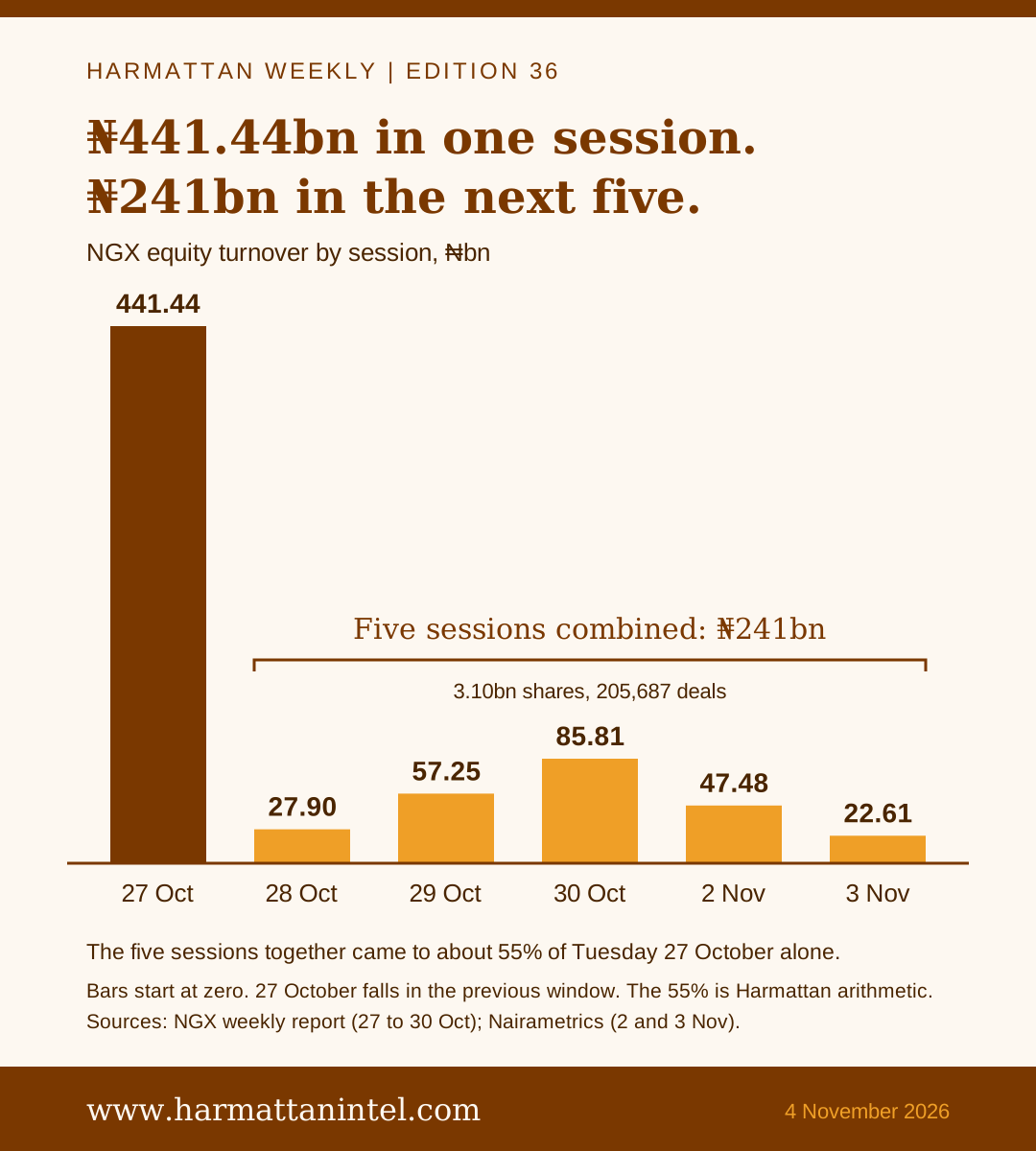
Trading thinned. Five sessions produced 3.10bn shares worth ₦241bn in 205,687 deals, using NGX figures for 28 to 30 October and Nairametrics for 2 and 3 November. Tuesday 27 October alone had traded ₦441.44bn, so the five sessions together came to about 55 per cent of that one day. The NGX weekly report, which runs Monday to Friday, shows the Banking Index down 3.42 per cent and the Industrial Goods Index up 14.58 per cent for the week to 30 October. Dangote Cement closed that Friday at ₦1,420, 5.82 per cent above its 27 October close. In the dollar market the CBN’s weighted average rate held between ₦1,346.26 and ₦1,347.94 from 28 October to 2 November, while daily turnover fell from $726.3m to $227.2m.
₦441.44bn on one Tuesday. ₦241bn across the five sessions that followed.
The Big Story
The central bank held a treasury bill auction on Wednesday 28 October on behalf of the Debt Management Office. It offered ₦800bn across three maturities. Investors bid ₦1.908tn and ₦71.16bn was sold, 3.73 per cent of the bids. Most of the demand sat in the one year bill: ₦1.84tn of bids against ₦600bn offered, of which ₦38.38bn was sold at a stop rate of 15.80 per cent, down from 15.90 per cent on 14 October. The stop rate is the highest yield the issuer accepted, so a bid above it was not filled. Daily Trust reported that one year bids ranged from 15.00 to 18.24 per cent. The 91 day bill sold ₦22.33bn at 15.40 per cent and the 182 day bill ₦10.45bn at 15.79 per cent. These figures come from press reports of the result, since the CBN’s own page was not available for this edition.
Set the result beside the rest of the money market. The auction repaid ₦130.72bn of maturing bills on 29 October and raised ₦71.16bn, so it returned ₦59.56bn more to the banking system than it took. The CBN’s open market operation bills, a separate instrument it sells to draw cash out of banks, cleared at 17.14 per cent for 180 days on 22 October. The overnight rate at which banks lend to each other averaged 20.00 per cent on every session in the CBN’s table from 28 October to 2 November, with a high of 28.50 per cent on Monday. Nairametrics reported banks’ placements at the standing deposit facility, where they park idle cash overnight at the floor of the CBN’s rate corridor, at ₦8.41tn on 28 October and ₦7.19tn on 30 October. The one year bill at 15.80 per cent sits 4.20 percentage points under the overnight average. Why the DMO took so little is not stated in anything Harmattan has read.
For an investor the question is the fill, not the stop rate. A stop rate marks the edge of what was sold, and a bidder’s return depends on whether the bid was filled at all. On 28 October fewer than four naira in every hundred bid were. A diaspora investor or institutional allocator who prices naira bills from the headline 15.80 per cent is pricing a rate that most of the bidding money did not receive. The 180 day open market bills cleared 134 basis points higher, on a shorter tenor, and the overnight market sat above both. Whether the pattern repeats will show in today’s result.
Nigeria’s Money
The 2026 Access to Financial Services survey from EFInA, weighted by the National Bureau of Statistics, puts formal financial inclusion at 73 per cent of adults, about 87.2 million people. It also finds that only 10.6 per cent of the formally included could raise ₦156,000 within seven days without difficulty, against 3.7 per cent of adults outside the formal system. Applied to 87.2 million adults, 10.6 per cent is about 9.2 million, which leaves roughly 78 million formally included adults who could not raise that sum without difficulty.
Hold that beside the money market. Banks had ₦7.19tn at the CBN’s standing deposit facility on 30 October. At ₦156,000 a person, that sum would cover about 46.1 million adults. The two amounts are not the same money, and the comparison is one of scale only. One describes the formal system from the household side and the other from the bank side, and the survey’s finding is that having an account and having a cushion are different things.
Africa Watch
Egypt’s central bank raised its overnight deposit rate by 100 basis points to 20 per cent on 29 October, with the lending rate at 21 per cent, according to Egypt Today and Arab Finance. Egypt Today reported the bank pointed to inflation pressure and external challenges. Nigeria’s MPC meets next on 23 and 24 November with the policy rate at 23 per cent. In Kenya, the follow up Edition 35 promised: the Central Bank of Kenya’s 29 October auction drew bids of KSh51.9bn against KSh28bn offered, up from KSh28.83bn on 22 October, a rise of 80.0 per cent. The CBK’s own page and the accepted rates were not read for this edition.
What to Watch
First, today’s treasury bill auction, with ₦800bn offered against maturities of about ₦872.55bn according to Nairametrics. Watch the amount allotted against the bids and whether the one year stop rate holds at 15.80 per cent, because that shows whether 28 October was a one off. Second, the Dangote refinery offer. Press reports give 10 November for the basis of allotment submission to the SEC and 17 November for its no objection, and no official source has confirmed either. The prospectus sets listing at allotment date plus 15 business days, which would be Tuesday 8 December if allotment falls on 17 November.
The next two documents to settle how much money there was and who received it are today’s auction result and the refinery’s allotment announcement. Harmattan will read both when they are published.
Methodology: Harmattan arithmetic covers derived percentages, the Tuesday to Tuesday window (27 October close to 3 November close) and conversions, calculated by Harmattan from the published figures.
Correction: Edition 35 gave Tuesday 27 October turnover as ₦441.47bn. The NGX weekly report gives ₦441.44bn.
Nothing published in Harmattan constitutes financial advice. Always consult a qualified financial adviser before making investment decisions.
Bestman Eleanya
Founder, Harmattan
hello@harmattanintel.com
www.harmattanintel.com