Edition 30 | 23 September 2026
For most of this year Nigeria has had two interest rates. One was printed in the Central Bank’s communiqués at 26.5 per cent. The other, the rate banks earn for leaving spare cash with the Central Bank overnight, sat at 22 per cent, and that was the one the market priced from. On Tuesday Governor Olayemi Cardoso closed the gap, cutting the Monetary Policy Rate by 350 basis points to 23 per cent and calling the decision what it was: a reset.
Market Wrap
The NGX All Share Index closed Tuesday at 250,614.66, up 2.58 per cent from 244,304.51 a week earlier, with all five sessions finishing higher. Market capitalisation rose 2.70 per cent to ₦162.68 trillion, above the ₦161.8 trillion of the 13 May peak, while the index remains about 0.75 per cent below the 252,508 it reached that day. The gap has a name. Abbey Bank listed 26.56 billion new shares from a private placement on 17 September, and new shares add to the value of the market without making any existing holding worth more. In dollars, the market rose from $119.17 billion to $122.52 billion. About 3.71 billion shares worth roughly ₦267 billion changed hands, and Friday’s 1.42 per cent advance was the week’s largest, with MTN Nigeria up 9.20 per cent to ₦890.
Tuesday was a session of concentration rather than breadth. Volume rose to 837.26 million shares worth ₦48.57 billion, yet deals fell by almost a quarter to 52,126: fewer, larger tickets. Zenith Bank led by value at ₦13.72 billion and the Banking Index rose 2.50 per cent on the day of the decision. Sovereign Trust Insurance led gainers with 9.95 per cent to ₦2.21, followed by Consolidated Hallmark at 9.82 per cent and Neimeth at 8.90 per cent. Multiverse Mining fell 9.86 per cent, Haldane McCall 9.39 per cent and Champion Breweries 8.68 per cent.
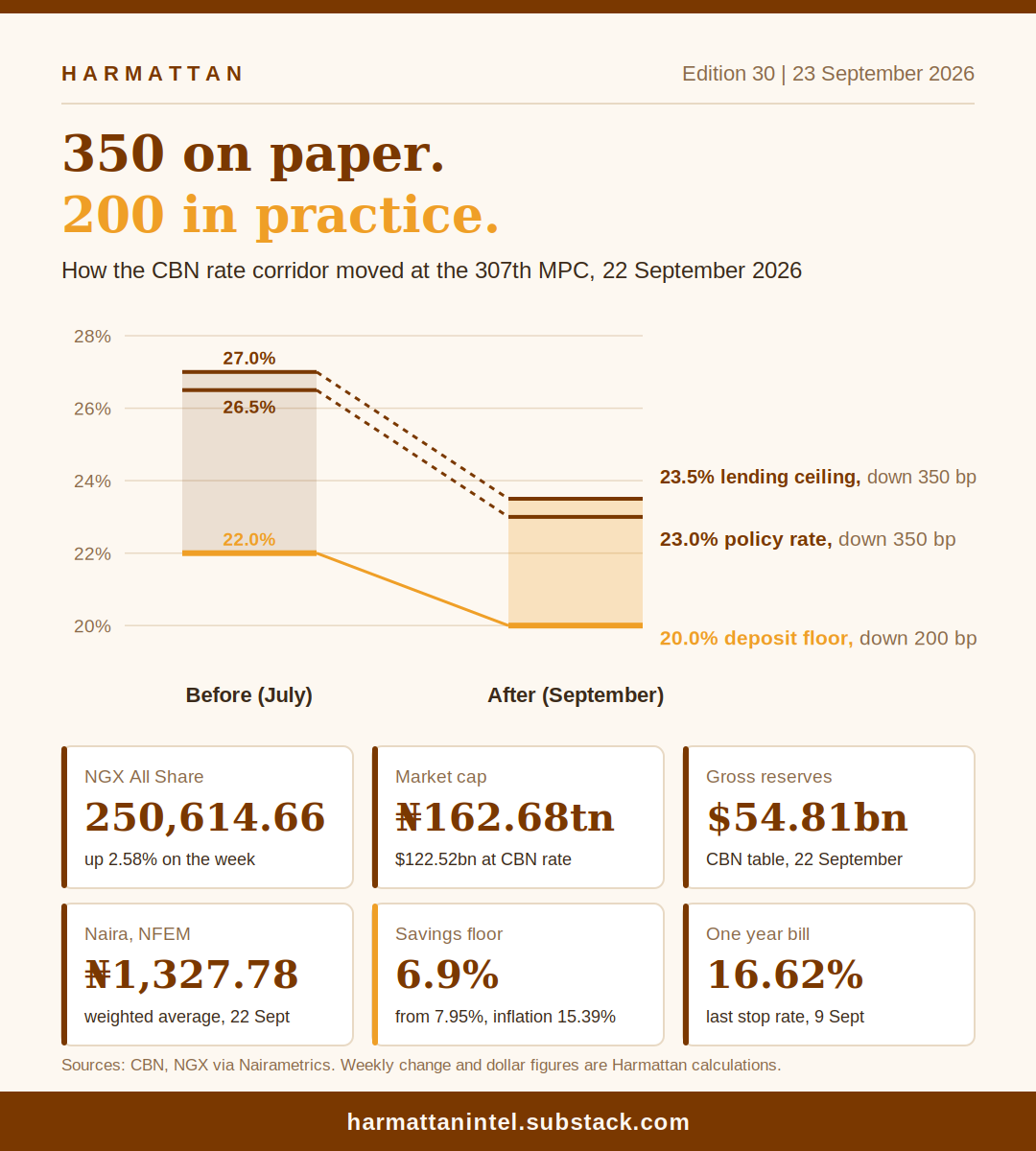
20 per cent. The rate Nigerian banks actually earn on idle cash fell 200 basis points on Tuesday, not 350, and the governor explained why himself.
The Big Story
The Monetary Policy Committee’s 307th meeting cut the benchmark rate to 23 per cent, kept the cash reserve requirement at 45 per cent for commercial banks, and narrowed the corridor around the policy rate from 50 basis points above and 450 below to 50 above and 300 below. The corridor sets a ceiling, at which banks borrow from the Central Bank overnight, and a floor, the standing deposit facility, at which the Central Bank pays them on spare cash. The ceiling fell 350 basis points to 23.5 per cent. The floor fell 200, from 22 per cent to 20 per cent. Mr Cardoso said why that matters: with the policy rate at 26.5 per cent and interbank near 22 per cent, the policy rate had become “the de jure rate with the SDF rate as the de facto.”
That distinction is the story for anyone pricing Nigerian money. Banks have long priced transactions off the deposit facility rather than the headline rate, so the easing that reaches the system is 200 basis points, not 350. Against August inflation of 15.39 per cent, the new floor still pays a real return of about 4.6 percentage points, and the 45 per cent of deposits banks must keep locked at the Central Bank is untouched. The Central Bank’s own table shows gross reserves at $54.81 billion on Tuesday, up $9.31 billion since December.
For a diaspora investor or an institutional allocator, three things follow. The one year Treasury bill, at 16.62 per cent on 9 September after three consecutive cuts, has been clearing well below both the old and the new floor, so the reset leaves room for bill yields to keep drifting lower. The currency held on the day, the official weighted average firming to ₦1,327.78 from ₦1,329.80 as turnover in the window roughly doubled to $694.58 million. And the reset lands in the week the US Federal Reserve raised rates for the first time since July 2023, so the gap between what naira and dollar assets pay has narrowed from both ends. Naira returns now lean more on the currency holding than on the yield.
Nigeria’s Money
The most direct transmission of Tuesday’s decision runs to the person with a savings account. Under Central Bank rules the minimum savings rate is 30 per cent of the policy rate. At 26.5 per cent that floor was 7.95 per cent; at 23 per cent it is 6.9 per cent. A trader in Onitsha holding ₦100,000 in savings earns ₦6,900 a year while the same basket of goods costs about ₦15,390 more. None of them was consulted, and most will learn of it from a revised rate notice.
In the same week, the state made its pitch for those savings. At a briefing in Abuja reported on 20 September, SEC Director General Emomotimi Agama and Nurudeen Zauro, the President’s technical adviser on financial inclusion, announced a National Savings Scheme backed by tax incentives, through which every Nigerian could save and have those savings invested. The scheme and a ten year Capital Market Master Plan are due at the State House on 19 October. A 6.9 per cent floor against 15.39 per cent inflation is a strong argument for moving money out of deposits. The test is whether the scheme reaches the trader in Onitsha on terms she can read before her money moves.
Africa Watch
Egypt offers a measure of what exchange rate credibility can do for a diaspora. The Central Bank of Egypt reported on 21 September that remittances from Egyptians abroad rose 28.1 per cent to $29.7 billion in the first seven months of 2026, from $23.2 billion a year earlier, with July alone at $4.5 billion. The central bank links the rise to its March 2024 reforms, which moved the pound towards a flexible rate and addressed foreign exchange shortages. Nigeria’s reforms rest on the same premise: that money from abroad comes through the banking system once the official rate is one people trust. Egypt’s Monetary Policy Committee meets on Thursday, with analysts split between a hold at 19 per cent and a 100 basis point increase.
What to Watch
Two numbers will show whether the reset is working. The first is today’s ₦500 billion Treasury bill auction, the first since the cut: a one year stop rate below 16.62 per cent means the easing is reaching the government’s own borrowing costs, while a hold means the market had already priced it. The second is the naira, which gave a little back on Wednesday to ₦1,328.50. Bismarck Rewane of Financial Derivatives warns lower rates could weaken demand for naira assets; AIICO Capital expects the rate to hold near ₦1,330.
For two years the Central Bank asked Nigerians to trust a policy rate the market had stopped using. On Tuesday it brought that rate back to where the money was. Bringing the saver’s return back to where prices are is the harder task, and it starts now.
Figures for the Tuesday to Tuesday window and the dollar conversion are Harmattan calculations, using Central Bank of Nigeria weighted average exchange rates.
Nothing published in Harmattan constitutes financial advice. Always consult a qualified financial adviser before making investment decisions.
Bestman Eleanya
Founder, Harmattan
hello@harmattanintel.com; harmattanintel.substack.com