Edition 35 | 28 October 2026
Dangote Refinery’s share offer was due to shut on Tuesday night, and the company said on Monday that “No further extension will be granted.” No count from the registrars, the SEC or the exchange had been published when this edition was prepared. What can be measured is the market the offer is about to enter, which closed Tuesday at 253,990.06, and how large one company would be inside it.
Market Wrap
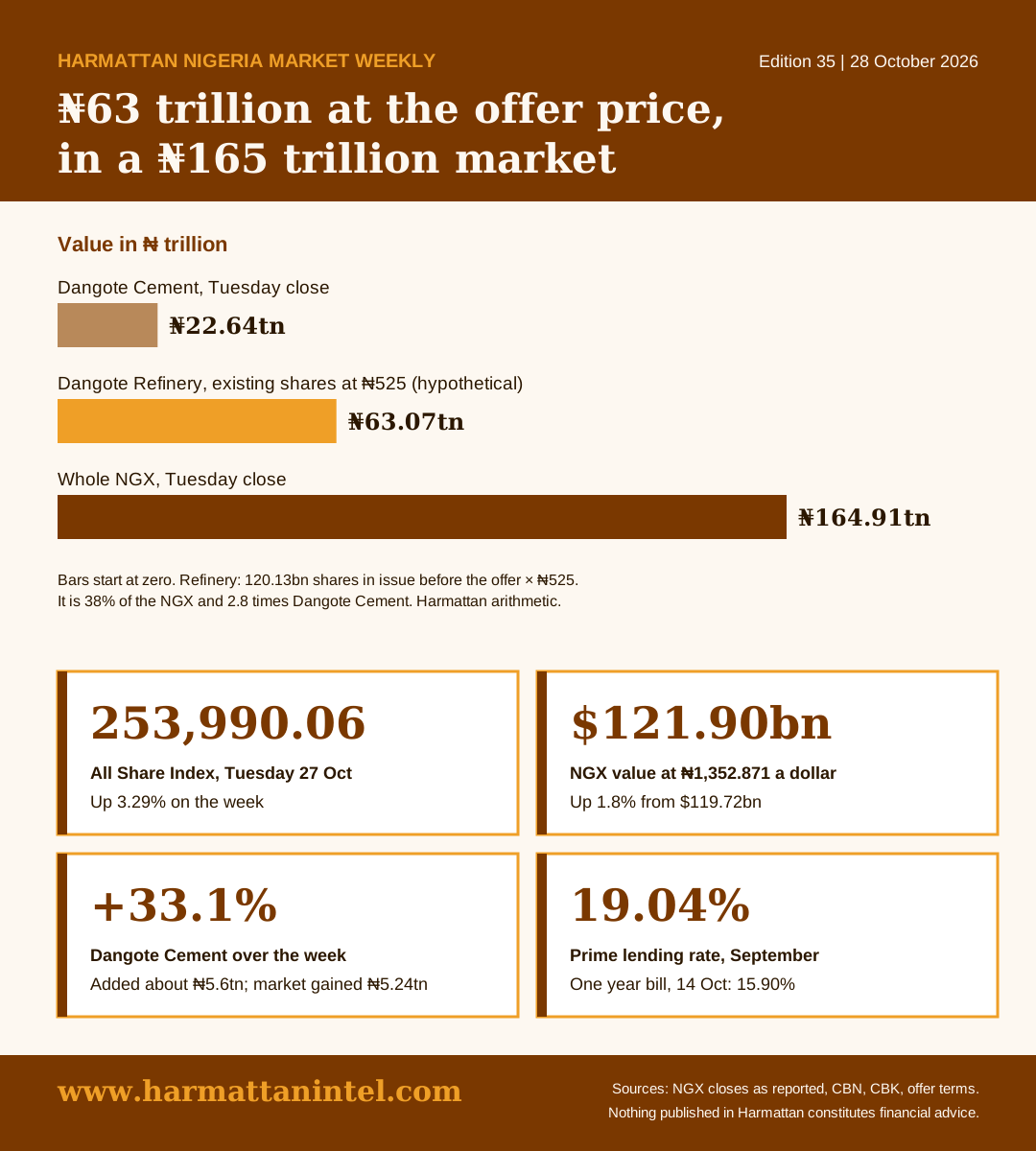
The NGX All Share Index closed Tuesday at 253,990.06, up 3.29 per cent on the 245,911.13 of a week earlier, and market capitalisation rose ₦5.24 trillion to ₦164.91 trillion. The index slipped on Wednesday and Thursday, then rose 0.92 per cent on Friday, 1.65 per cent on Monday and 1.07 per cent on Tuesday. At Tuesday’s Central Bank weighted average rate of ₦1,352.871, the exchange is worth $121.90 billion, up 1.8 per cent from $119.72 billion a week ago. That is a smaller gain than in naira because a dollar now costs ₦19.22 more than it did then.
One stock supplied more than the whole gain. Dangote Cement rose 33.1 per cent over the week, from ₦1,008 to ₦1,341.90, including 10.00 per cent on Monday and 9.80 per cent on Tuesday. That added about ₦5.6 trillion to its value, now ₦22.64 trillion, against the ₦5.24 trillion the whole market gained, so the rest of the exchange ended about 0.3 per cent lower. That is arithmetic, not an explanation. Tuesday’s other leaders were UPDC REIT, up 10.00 per cent to ₦19.25, and Honeywell Flour Mill, up 9.67 per cent to ₦21.55. Presco fell 10.00 per cent to ₦1,840.80, Tripple Gee 9.93 per cent to ₦2.54 and Thomas Wyatt 9.85 per cent to ₦2.47. Tuesday turned over ₦441.47 billion across 5.23 billion shares.
₦63.07 trillion. What Dangote Refinery’s existing 120.13 billion shares come to at the ₦525 offer price, against ₦164.91 trillion for the entire exchange.
The Big Story
The offer is for 4.1 billion shares at a fixed ₦525, a gross ₦2.1525 trillion. The prospectus, as reported, puts the shares in issue before the offer at 120.13 billion. At ₦525 that is ₦63.07 trillion, or about $46.6 billion, which is 38 per cent of the value of the whole exchange today and 2.8 times Dangote Cement’s ₦22.64 trillion. It is a hypothetical, because ₦525 is an offer price and not a market price. How the exchange will count the shares in its capitalisation and its index depends on rules this edition has not read.
Put that beside the yardstick in the SEC’s new Capital Market Master Plan. Among its indicators, the plan tracks the capitalisation of listed companies against GDP, with dollar values attached: 33 per cent, or $96 billion, in 2025, rising to 41 per cent, or $167 billion, by year three. The exchange is already worth $121.90 billion. Add the refinery’s ₦63.07 trillion to today’s ₦164.91 trillion and the total is about ₦228 trillion, or $168.5 billion at Tuesday’s rate, above the plan’s year three figure. Read that as interpretation. One listing could meet the first milestone on the day it begins trading, whatever happens to every other company. The plan also sets targets for listed companies, 146 rising to 176 by year three, and for retail investors, 6 million rising to 10.2 million. One listing moves the first by one.
The baseline raises a question for the Commission, not a charge. Thirty three per cent of the plan’s own 2025 GDP of $377.4 billion is $124.5 billion, not $96 billion. Its baseline table lists equity capitalisation at ₦146.5 trillion for 2026, which at $96 billion implies ₦1,526 to the dollar, while its GDP figures of ₦442 trillion and $377.4 billion imply about ₦1,171. The plan dates that 33 per cent to 2025 in its targets table, citing the World Bank, and to 2026 in its baseline table, as a “Genesis Calculation”, so the gap may be one of dates as much as rates. For a diaspora investor or an allocator the lesson is practical. A target set in dollars moves with the naira as well as with prices, and a ratio can be met by a single listing. Ask which exchange rate the scorecard will use, and whether it will report companies and investors beside value.
Nigeria’s Money
The Central Bank has published September’s money market indicators, which show how far a lower policy rate has reached borrowers. Since July the policy rate has fallen from 26.50 per cent to 23.00 per cent. The average prime lending rate, which banks charge their strongest customers, went from 19.06 per cent to 19.04 per cent. The maximum lending rate, the highest banks report charging anyone, went from 33.16 per cent to 32.62 per cent. The table does not say why.
Set that against what savers can earn and the state pays. The one year Treasury bill cleared at 15.90 per cent on 14 October, and on 22 October the Central Bank sold ₦2.63 trillion of open market bills at marginal rates of 17.14 to 17.63 per cent. The weekly valuation report on collective investment schemes, the pooled funds many Nigerians save through, shows where that money sits. For the week ended 9 October, money market funds held ₦6.72 trillion, 68 per cent of all fund assets, with 927,990 unitholders and reported yields averaging 16.85 per cent. Equity funds held ₦239.4 billion, 2.4 per cent, with 136,930 unitholders. Read as interpretation, formal savers are paid about what the government pays, while a small trader borrowing near the maximum rate pays almost twice that.
Africa Watch
Kenya’s Treasury bill auction on 22 October drew far less than the week before. Bids totalled KSh28.83 billion against KSh28 billion offered, down from KSh68.50 billion a week earlier, a fall of 57.9 per cent. The 91 day bill saw the sharpest drop, with bids of KSh14.34 billion against KSh49.80 billion, down 71.2 per cent. The 182 day and 364 day bills drew bids equal to 76.9 per cent and 68.0 per cent of what was offered. The Treasury accepted KSh28.79 billion, 99.9 per cent of everything bid. One week of thinner demand does not make a trend. The auction on 29 October will be the second reading, and it will show whether the fall repeats.
What to Watch
First, Dangote Cement’s third quarter results, which had not been published when this edition was prepared. They will be read against a share price that rose 33.1 per cent in the week and a value of ₦22.64 trillion. Second, Tuesday 3 November, when collation of the refinery offer is reported to be due. An official count from the registrars, the SEC or the exchange would turn this edition’s arithmetic from a scenario into a number, and the reported dates that follow, 10 November for the basis of allotment and 17 November for the Commission’s no objection, set the pace for the listing itself.
The size of a market is announced; the cost of money is paid. Nigeria needs both numbers moving the right way before either counts as progress, and Harmattan will keep them on the same page.
Tuesday to Tuesday changes, dollar conversions, Dangote Cement’s weekly contribution, the refinery’s value at the offer price and the ratios built on it, the fund shares and yield, and the Kenyan auction percentages are Harmattan calculations from NGX closes as reported, CBN rates and results, CBK results, the offer terms and the plan’s tables.
Nothing published in Harmattan constitutes financial advice. Always consult a qualified financial adviser before making investment decisions.
Bestman Eleanya
Founder, Harmattan
hello@harmattanintel.com
www.harmattanintel.com