

Harmattan | Edition 20 | Wednesday, July 15, 2026
The Nigerian market spent this week doing something it has rarely done in 2026: hesitating. Two days of gains, a flat Friday, a Monday wobble, and then a Tuesday recovery that felt less like exuberance and more like discipline. And this morning, while Lagos traders were still settling into their desks, the National Bureau of Statistics handed the Central Bank a number that will shape everything that happens next week.
Market Wrap
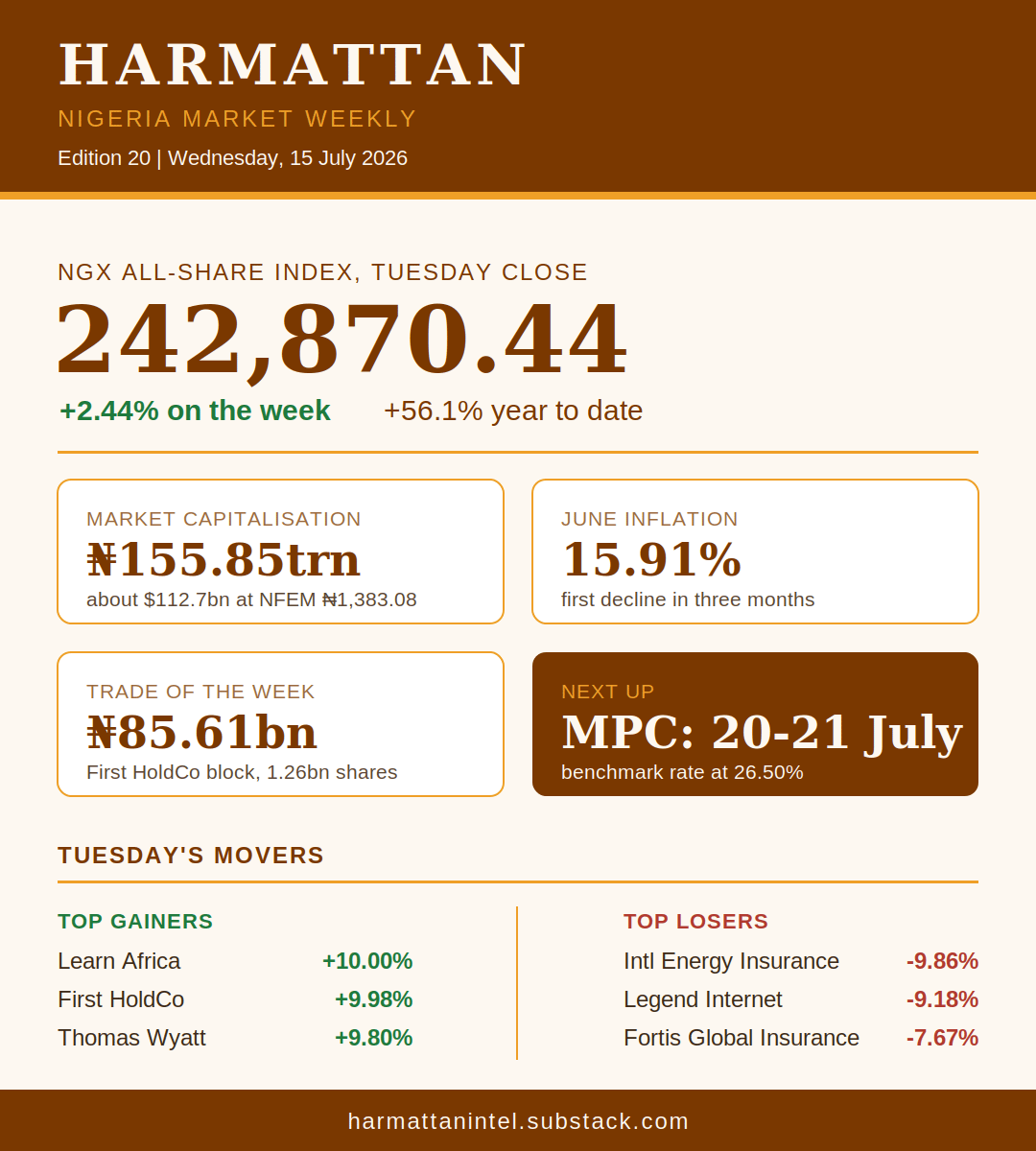
The All-Share Index closed the Harmattan coverage week at 242,870.44 on Tuesday, up 2.44 percent from the prior Tuesday’s 237,083.28 and now 56.1 percent higher for the year. Market capitalisation ended at 155.85 trillion naira, roughly 112.7 billion dollars, adding 3.72 trillion naira of investor wealth in seven days. Dollar figures are calculated at the CBN’s NFEM closing rate of 1,383.08 naira on Tuesday July 14 and applied to headline figures only. Our Tuesday-to-Tuesday figure sits below the 6.35 percent the exchange reported for its own Friday-to-Friday week because that window captured the early-July surge that closed before ours opened. The shape of this week told its own story: a 2.27 percent leap on Wednesday as Airtel Africa touched a 52-week high, a Thursday session dominated by First HoldCo, a flat Friday marred by Guinness falling 9.99 percent, a Monday retreat of 0.84 percent to 241,749.11, and a Tuesday recovery of 0.46 percent with 30 advancers against 25 decliners. The market tested the 240,000 shelf and held it.
Tuesday’s leaderboard belonged to Learn Africa, up the maximum 10 percent to 9.90 naira, First HoldCo, up 9.98 percent to 72.15 naira, and Thomas Wyatt, up 9.80 percent barely a week after its trading suspension was lifted. International Energy Insurance led the losers, down 9.86 percent, followed by Legend Internet, down 9.18 percent, and Fortis Global Insurance, down 7.67 percent. Turnover on Tuesday alone reached 634.74 million shares worth 53.33 billion naira in 42,430 deals, but Thursday was the week’s true spectacle, when a single negotiated block of First HoldCo crossed the market. The official weekly turnover aggregate lands with the NGX report on Friday.
One block of 1.26 billion First HoldCo shares worth 85.61 billion naira crossed the tape in a single session. That is not retail enthusiasm. That is conviction with a calendar.
The Big Story
Nigeria’s headline inflation fell to 15.91 percent in June, from 15.93 percent in May. The margin is a rounding error. The direction is not. After three consecutive months of rising prices, driven largely by the oil shock that followed the collapse of the US and Iran ceasefire, the headline finally turned. Beneath it, the picture is genuinely split. Core inflation, which strips out volatile food and energy prices, dropped sharply to 15.92 percent from 16.82 percent, a fall of nearly a full percentage point in one month. But food inflation went the other way, rising to 17.52 percent year on year, with monthly food prices climbing 3.75 percent. In Kogi State, food prices are 53.02 percent higher than a year ago. The economist sees disinflation. The market woman in Lokoja does not.
The timing is everything. The Monetary Policy Committee sits on Monday and Tuesday, July 20 and 21, its first meeting since holding the benchmark rate at 26.50 percent in May. This print is the last major data point it will see. The case for caution writes itself: oil is holding above 85 dollars a barrel on renewed Hormuz risk, the naira eased about 1.2 percent this week to 1,383 at the official window, and food, the largest single item in every Nigerian household budget, is still accelerating. The case for optimism is quieter but real: core inflation falling that fast suggests the exchange rate pass-through from March’s fuel shock is fading, and that underlying price pressure is genuinely cooling.
For the diaspora investor and the institutional allocator, the decision itself is probably the least interesting part. Most analysts expect a hold, and a hold at 26.50 percent keeps Nigerian fixed income among the most attractive carry trades in frontier markets. Watch the language instead. If the committee’s statement leans on core disinflation, it is telling you a cutting cycle is being prepared for later this year, and that changes the arithmetic for equities, where a 56 percent rally has been running partly on exactly that expectation. If the statement leans on food and oil, the wait gets longer. Either way, the earnings wall arriving in the last week of July will decide whether these prices have profits underneath them.
Nigeria’s Money
Nigeria has spent a decade solving payments. It has barely begun solving credit. That is what makes Friday’s announcement worth your attention: the Nigerian Consumer Credit Corporation, CREDICORP, signed a risk-sharing agreement with the National Credit Guarantee Company under which the guarantee company will absorb part of the default risk on consumer loans issued through CREDICORP’s network of participating banks and lenders, starting with personal loans and household asset financing. In plain English, the state is offering to share losses with any lender willing to extend credit to ordinary Nigerians, because without that cushion, most will not. The average Nigerian household still borrows the way it always has, from family, from friends, from the trader’s association, from the moneylender whose interest rate is negotiated in shame rather than basis points.
The honest caveat is that CREDICORP’s scheme launched in 2024 by lending to federal civil servants, the most documented, most payroll-verified workers in the country. A memorandum of understanding is a promise, not a disbursement. The real test of this partnership is whether guaranteed credit ever reaches the woman whose shop turns over more than a civil servant’s salary but whose income exists nowhere on paper. If it does, something quietly profound happens: her repayment history becomes data, the data becomes a credit score, and the informal economy begins writing itself into the formal one, loan by loan. That is the version of financial inclusion that builds wealth rather than merely moving cash.
Africa Watch
Ghana is offering the continent a lesson in what happens after a great rally. The Accra bourse remains Africa’s best performer this year, its composite index up roughly 129 percent over twelve months after crossing 15,000 points in March, powered by a stabilising cedi and the violent re-rating of banks that had been crushed by the domestic debt restructuring. But the index has added barely one percent in the past month and now sits near 14,800, with market capitalisation around 24.9 billion dollars. Recovery rallies are ferocious and finite. Ghana’s is maturing just as Nigeria’s, with a far deeper market and a September index reclassification ahead, is still finding new buyers. Allocators comparing the two are really asking one question: which market still has fuel in the tank?
What to Watch
Two dates matter this coming week. First, the MPC decision on Tuesday July 21: not the rate itself, which is widely expected to hold at 26.50 percent, but the statement’s treatment of the core-versus-food divergence, because that language will set the tone for fixed income yields and the equity market’s rate-cut hopes through September. Second, First HoldCo’s results, expected around July 24: after a week in which an 85.61 billion naira block trade and a 9.98 percent Tuesday surge made it the market’s main character, this will be the first big bank print of the earnings season, and the first hard evidence of whether the year’s most dramatic banking rally is built on profit or on positioning.
The market held its ground this week, and the inflation tide finally turned, however slightly. What happens next will not be decided by sentiment. It will be decided in a committee room in Abuja and on the earnings pages of the banks. Harmattan will be reading both.
Nothing published in Harmattan constitutes financial advice. Always consult a qualified financial adviser before making investment decisions.
Bestman Eleanya
Founder, Harmattan
hello@harmattanintel.com
harmattanintel.substack.co
m