Harmattan | Edition 27 | 2 September 2026
Market Wrap
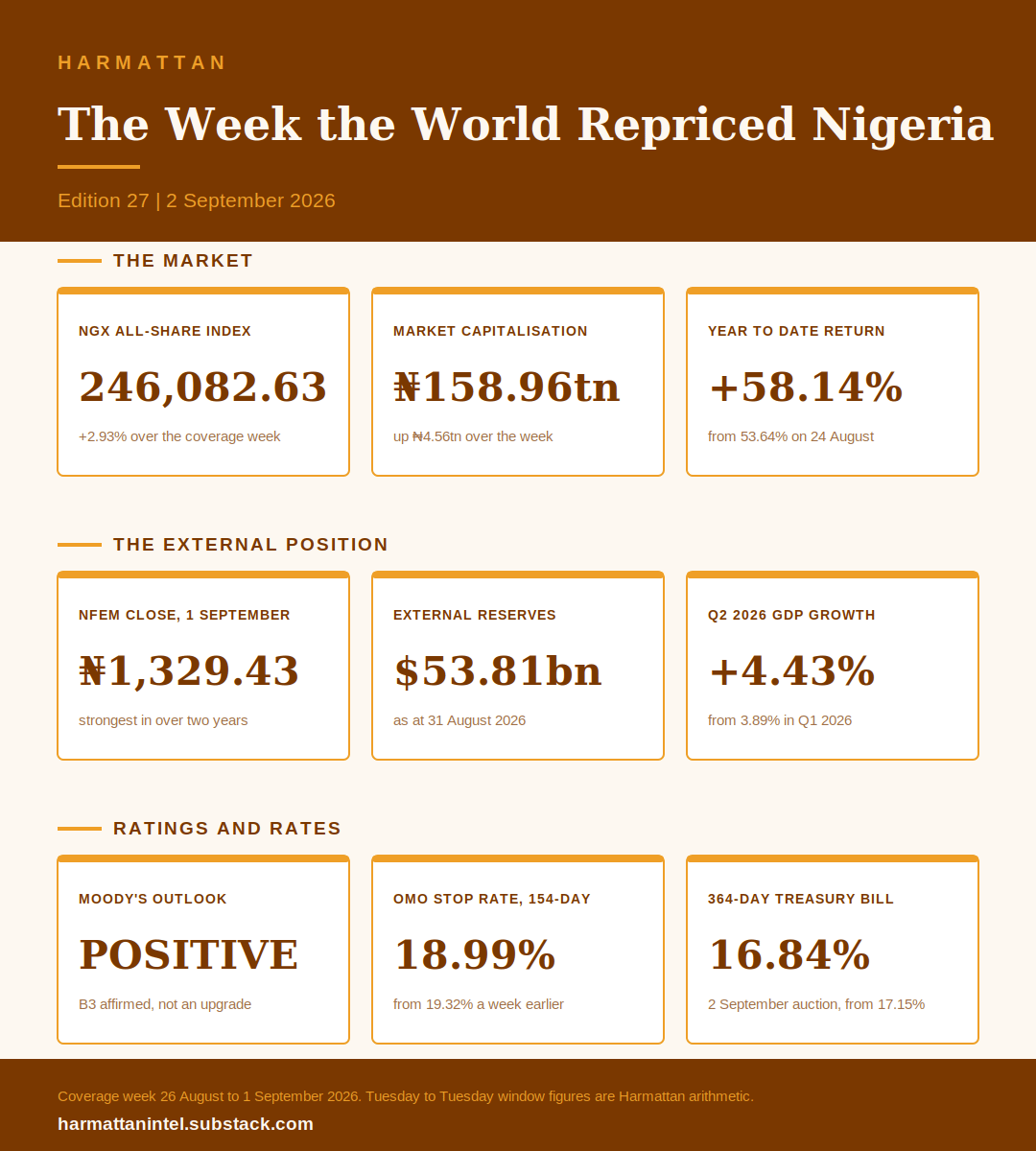
The Nigerian Exchange closed on Tuesday 1 September at 246,082.63 points, up 0.77 per cent on the session and higher for a fourth consecutive day. Capitalisation stood at ₦158.96 trillion. Across Harmattan’s coverage week, which opens against the Monday 24 August close of 239,085.17 because Tuesday 25 August was a public holiday, the index added 6,997.46 points, or 2.93 per cent, and capitalisation rose ₦4.56 trillion, or 2.95 per cent, lifting the year to date return from 53.64 per cent to 58.14 per cent. Capitalisation outran the index partly because Sunu Assurances, Coronation Insurance and Sterling Financial Holdings all listed additional shares on 31 August, so some of that gain is new paper rather than higher prices. Figures for the Tuesday to Tuesday window, and the conversions below, are Harmattan arithmetic.
Only the first session of the week fell. Wednesday 26 August dropped 0.17 per cent and stretched the losing run to eleven, after which the market rose 0.20, 0.90, 1.20 and 0.77 per cent on the four days that followed. Tuesday’s turnover reached ₦40.77 billion on 651.32 million shares in 43,760 deals, with 40 stocks advancing. Aradel Holdings gained 8.83 per cent to ₦1,539.90 and Nestlé Nigeria 5.83 per cent to ₦2,995.00. Underneath all of it sits the currency. The naira closed Tuesday at ₦1,329.43 on the Nigerian Foreign Exchange Market, its strongest in more than two years and the first close below ₦1,330 since May 2024, having begun the window at ₦1,346.98. That changes how the market reads from outside. In local terms capitalisation grew 2.95 per cent. Converted at the official rate on each anchor date, it grew from $114.63 billion to $119.57 billion.
₦158.96 trillion at home, $119.57 billion abroad. The second figure grew faster than the first, and none of that gap came from a share price.
The Big Story
On Friday 28 August, Moody’s revised Nigeria’s sovereign outlook from stable to positive. Precision matters here, because in Abuja it has been received as something considerably larger. Moody’s did not upgrade Nigeria. It affirmed the long term issuer ratings at B3, six notches below investment grade, and changed only the direction of travel. The agency cited sizeable current account surpluses, a material accumulation of external reserves, better functioning in the foreign exchange market, and monetary policy transmission it described as more effective but still weak. It projected a current account surplus near 6.1 per cent of GDP this year.
The domestic evidence arrived three days later. On Monday the National Bureau of Statistics put second quarter growth at 4.43 per cent year on year, up from 3.89 per cent in the first quarter. The composition is more interesting than the headline. Services grew 4.60 per cent and now account for 56.62 per cent of real output, while agriculture grew 4.39 per cent against 2.82 per cent a year earlier, which in a country where most working people are nearer a farm than a trading floor is the most consequential line in the release. Industry slowed to 3.96 per cent from 7.46 per cent. Oil expanded 7.31 per cent on production of 1.72 million barrels a day, up from 1.55 million in the first quarter. Reserves reached $53.81 billion by 31 August, and Brent traded near $95 on Tuesday after strikes around the Strait of Hormuz. Nigeria sells what the world is suddenly short of, and the reserves, the currency and the ratings note all rest on that.
What did not make the front pages here is that the same week repriced Nigeria’s cost of capital in the opposite direction. The yield on the United States ten year Treasury note passed 4.75 per cent for the first time since January 2025, the German ten year Bund reached a fifteen year high, and a governor of the Federal Reserve said publicly that he would support a rate rise if inflation does not cool. Global money is being offered more to stay at home than at almost any time in a generation. Nigeria is asking that same money to travel to a market six notches below investment grade, on the strength of an index reclassification taking effect on 21 September, against passive inflow that Cordros Research has estimated at between $840 million and $1.04 billion. That is a projection, not a commitment. Cordros made a second observation in the same note that has travelled less far: Nigeria recorded a net foreign inflow of ₦161.05 billion in 2025, of which ₦263.30 billion arrived in September alone. A year of foreign enthusiasm was, on inspection, four weeks of it. For the institutional allocator, the improvement is real and the discount is also real, and the second will not close because of the first. For the diaspora investor the read is plainer. This year’s gains have come overwhelmingly from Nigerians buying Nigerian shares.
Nigeria’s Money
On Tuesday the Securities and Exchange Commission published draft Rules on Online Forex Trading and Contracts for Difference, and in doing so formally acknowledged a market Nigeria has never counted. Under the proposals a market making broker would need ₦3 billion in paid up capital, a straight through processing or ECN broker ₦2 billion, and a technology or platform provider ₦5 billion. Client money would sit in segregated accounts at CBN licensed banks and be reconciled daily. Binary options would be banned outright for retail clients. Cold calling would go, along with unapproved influencer promotion and incentives tied to trading volume. Most importantly, an offshore platform falls inside the rules if it lets Nigerians open accounts, advertises here, or pays Nigerian affiliates.
That last clause is the whole story. No NGX report measures this market and no NBS series captures it. The money leaves by card or stablecoin, sits with a broker in Limassol or Port Louis, and returns, when it returns, as a bank credit nobody classifies. It has been sold to young Nigerians as a way out, promoted by people paid for each signup, at leverage that turns a small adverse move into a total loss. The draft would cap that leverage at 1:400 on the major currency pairs, which Proshare has already called generous by international standards, since it still allows ₦100,000 to control a ₦40 million position. There is also a tension the Commission will have to live with. Capital floors of this size will clear out nearly every domestically incorporated operator, while the offshore platforms holding most of the money face a choice between registering and simply going quieter. Formalising a market and pricing everyone out of it are close cousins. Operators would have three months to apply and six to comply, which makes early 2027 the real test.
Africa Watch
Kenya reported August inflation of 6.6 per cent on Monday, up from 6.5 per cent and above the midpoint of the central bank’s 2.5 to 7.5 per cent target range for a fifth consecutive month. Transport led at 15.7 per cent, and core inflation quickened to 3.4 per cent from 3.2 per cent, which is the tell: the fuel shock is no longer confined to fuel. The symmetry is instructive. The same barrels that are strengthening the naira, filling Nigeria’s reserves and underwriting a positive outlook from Moody’s are raising matatu fares in Nairobi and boxing in a central bank that has held at 8.75 per cent since April. One shock, two very different weeks, and the only difference is which side of the trade you sell from.
What to Watch
Two things. The FTSE Frontier Index Series indicative review files began publishing today, and until now every figure attached to 21 September has been an estimate. These files replace estimates with weights and a constituent list, and they are the first hard read on how much passive money is genuinely attached to Nigeria and to which shares. Then 21 and 22 September, when the Monetary Policy Committee meets on the very day the reclassification takes effect. The committee still holds at 26.5 per cent, but the market has moved without it. OMO stop rates fell to 18.99 per cent on Tuesday from 19.32 per cent a week earlier, and at today’s auction the 364 day Treasury bill cleared at 16.84 per cent, down from 17.15 per cent and below 17 per cent for the first time. Domestic yields are falling while global yields rise, and that gap is now the most important number in Nigerian finance.
Nigeria’s price has for a decade been set by institutions that rarely visit. This month two of them changed their minds, and ₦4.56 trillion followed. The test that counts is whether any of it reaches the person who still cannot get a loan, and that is the one worth keeping count of.
Nothing published in Harmattan constitutes financial advice. Always consult a qualified financial adviser before making investment decisions.
Bestman Eleanya
Founder, Harmattan
hello@harmattanintel.com, harmattanintel.substack.com