Edition 33 | 14 October 2026
On Monday the Dangote Petroleum Refinery share offer was given two more weeks. On Tuesday, the day it had been due to close, the refinery reported nine months of results that its prospectus did not contain: $22.48 billion of revenue and $4.73 billion of profit after tax, against a loss in the same period a year earlier. Anyone who has not yet applied now has until 27 October to read them. The rest of the market, meanwhile, kept slipping.
Market Wrap
The All Share Index closed Tuesday at 247,513.63, down 1.10 per cent from 250,273.50 a week earlier, and capitalisation fell by the same margin to ₦160.71 trillion. Nine of the ten sessions since 28 September have closed lower, Friday’s 0.13 per cent rise the only exception. In dollars, at the Central Bank’s weighted average rate of ₦1,332.97, the market was worth about $120.56 billion, against $122.10 billion a week earlier. Two changes to the share register passed through the week. Guinea Insurance listed 6.31 billion new shares from a private placement on Wednesday, and on Thursday Sterling Financial Holdings returned to trading after a reconstruction that replaced 68.5 billion shares with 6.85 billion priced at ₦77.
Tuesday’s 394 million shares changed hands for ₦21.38 billion, and the five sessions together turned over about 2.06 billion shares worth about ₦122.6 billion. eTranzact led Tuesday’s gainers, up 9.96 per cent to ₦14.35, followed by Wapic Insurance at 7.83 per cent and DAAR Communications at 7.25 per cent. Legend Internet fell 6.85 per cent to ₦3.40, Omatek Ventures 6.43 per cent and Secure Electronic Technology 5.71 per cent. The Nigerian Overnight Financing Rate, which the Central Bank now names as its operational benchmark, printed 20.00 per cent, the floor of its corridor, in every session, and ₦6.47 trillion changed hands on Tuesday alone.
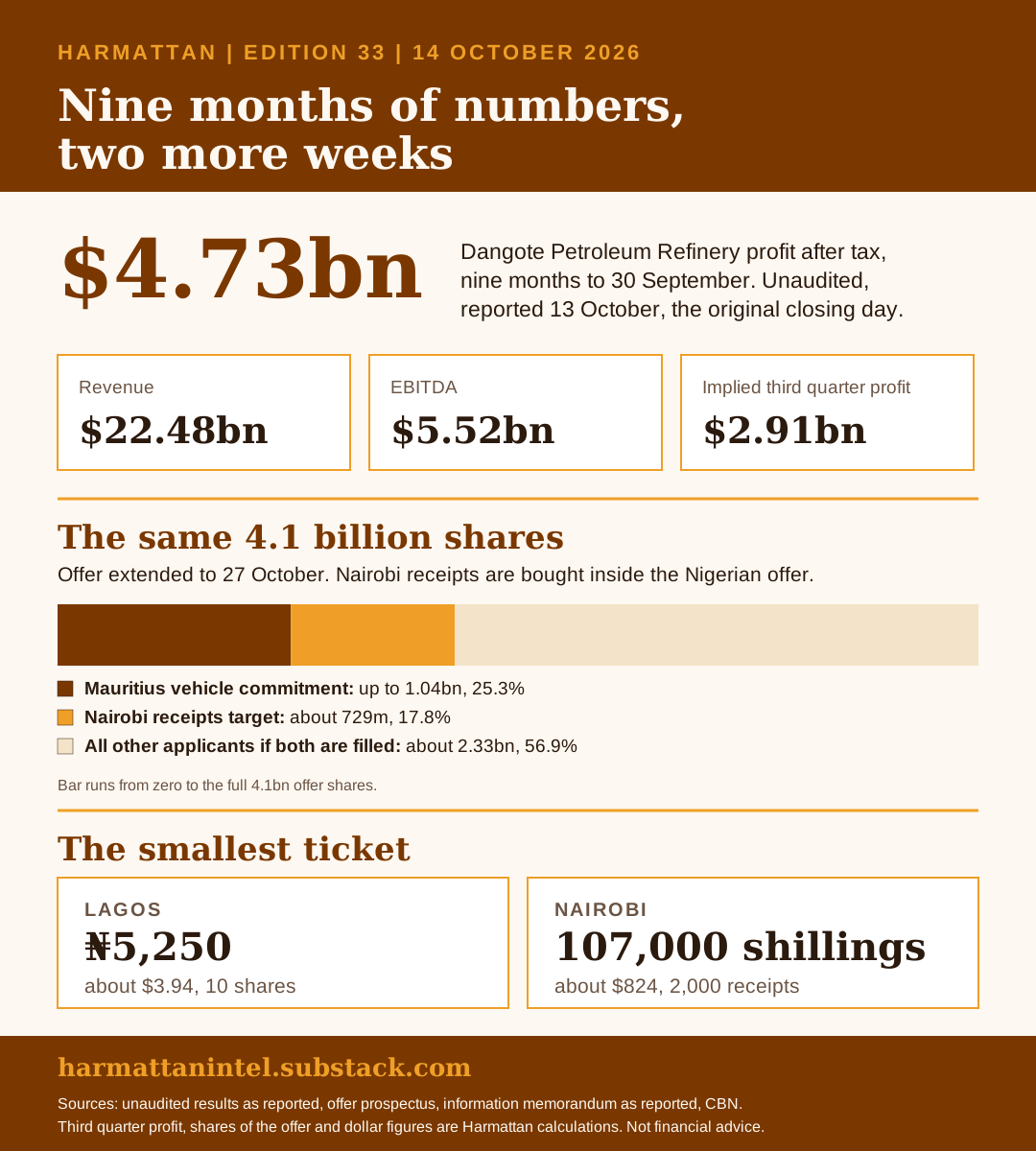
$4.73 billion. Nine months of profit at the Dangote refinery, reported on the day its share offer had been due to close.
The Big Story
The unaudited results cover the nine months to 30 September. Revenue rose to $22.48 billion from $9.19 billion, and earnings before interest, tax, depreciation and amortisation reached $5.52 billion. The refinery ended September with $6.69 billion of cash and net cash of $650.8 million, against net debt of $1.73 billion a year earlier. The prospectus put first half profit at $1.82 billion, which leaves about $2.91 billion for the third quarter alone. David Bird, the chief executive, said the numbers “provide a solid foundation as we progress through our IPO”.
They also change how the price reads. At listing the prospectus values the company at ₦65.22 trillion, about $48.9 billion at Tuesday’s rate, or roughly ten times nine months of profit. The results are unaudited, one quarter carries most of the profit, and refining margins move with crude and product prices, so no one should annualise them with confidence. Compare the earlier investors. The $2.5 billion private placement completed in June and July bought 7.15 billion shares, about $0.35 each. A naira applicant paying ₦525 today pays about $0.39, roughly 13 per cent more, for a company that has since reported a stronger quarter.
The extension is the other half of the week. The company’s notice, as reported, ties it to wider access across Africa, including depositary receipt programmes. Those receipts are not extra stock. Under the structure Kenya’s Capital Markets Authority approved, Renaissance Capital Kenya collects local money and Renaissance Capital Africa applies for shares in the Nigerian offer; the receipts are created only after those shares are allotted. The East African information memorandum targets about 729 million receipts, each backed by one share, or about 17.8 per cent of the 4.1 billion shares on offer. Add the Mauritius vehicle’s commitment of about 1.04 billion shares, and channels outside Nigeria could take about 43 per cent of the offer if both are filled.
Mr Dangote told reporters that subscriptions already amount to “more than three or four times” the target. No registrar, issuing house or regulator has published a figure. If his description proves right, the allotment rules rather than the closing date will decide how much of the 4.1 billion shares reaches applicants in Nigeria. For a diaspora investor applying through a Nigerian broker, that is the number to wait for.
Nigeria’s Money
A Nigerian applicant gets into the refinery for far less than a Kenyan one. The minimum application is ten shares, ₦5,250, about $3.94 at Tuesday’s rate. A Kenyan buying through the Nairobi route must take at least 2,000 receipts at 53.50 shillings, or 107,000 shillings, about $824 at the exchange rate implied by the memorandum’s own figures. The smallest ticket in Nairobi is roughly 209 times the smallest in Lagos. Each receipt also works out at about $0.41, against the $0.39 a naira applicant pays per share. The reporting on the memorandum does not say what that gap covers.
A low price is not the same as access. A Nigerian applicant still needs a broker or bank channel, identity checks that clear and a payment that settles before the list closes, and the reason given for the extension concerns markets elsewhere in Africa, not those steps at home. The basis of allotment, due at the Securities and Exchange Commission in November, will show how many Nigerians a ₦5,250 ticket actually brought in.
Africa Watch
Ghana’s annual inflation rose to 5.2 per cent in September from 5.0 per cent in August, its second monthly rise, according to the Ghana Statistical Service’s release on 7 October. It remains below the Bank of Ghana’s target band of 6 to 10 per cent, and the central bank held its policy rate at 14 per cent on 24 September, about nine percentage points above the new inflation figure. Ghana shows that prices can turn up again from below target even with a high real rate in place. That is worth keeping in view in Abuja, where the Monetary Policy Committee reset its rate last month with headline inflation at 15.39 per cent.
What to Watch
First, the result of today’s Treasury bill auction, the second of the quarter. The government offered ₦450 billion, ₦350 billion of it in one year bills, against only ₦80.84 billion maturing at settlement, so most of it is new borrowing. The one year bill cleared at 15.85 per cent on 7 October; a higher stop rate would be the first rise since the reset. Second, the Capital Market Conversation at the State House on Monday, where the National Savings Scheme is due to be launched. Its tax incentives have been promised but not described, and who qualifies, for how much and in what instrument will decide whether the scheme reaches new savers or only people who already invest.
A share offer is a conversation conducted in documents. This week the refinery added new numbers and a new deadline, and the people with the least time to read them are the ones an offer billed as the IPO for the People says it was built for.
Correction: Edition 32 reported 579.25 million shares, ₦36.07 billion and 41,072 deals for 6 October, taken from a market snapshot. The NGX weekly report gives 579.17 million shares, ₦36.06 billion and 40,979 deals.
Tuesday to Tuesday changes, five session turnover, dollar conversions, the refinery’s valuation in dollars and against its profit, the third quarter profit, per share prices for the placement, the public offer and the Nairobi receipts, the receipts’ share of the offer and the minimum ticket comparison are Harmattan calculations, using NGX closing figures, Central Bank of Nigeria weighted average exchange rates, the offer prospectus and published offer terms.
Nothing published in Harmattan constitutes financial advice. Always consult a qualified financial adviser before making investment decisions.
Bestman Eleanya
Founder, Harmattan
hello@harmattanintel.com; harmattanintel.substack.com