Edition 28 | Wednesday 9 September 2026
The index finished the week almost exactly where it started. Almost nothing else about the week was ordinary.
Between last Tuesday’s close and this one, Nigerian equities crossed ₦160 trillion for the first time since 10 August, handed the whole crossing back in a single session, and watched the largest company the country has ever built sign the papers that will bring it to Customs Street. The index ended lower than it began. Capitalisation ended roughly flat, even though billions of new shares were added along the way. A market that has climbed almost vertically all year spent this week standing still while the ground beneath it moved.
Market Wrap
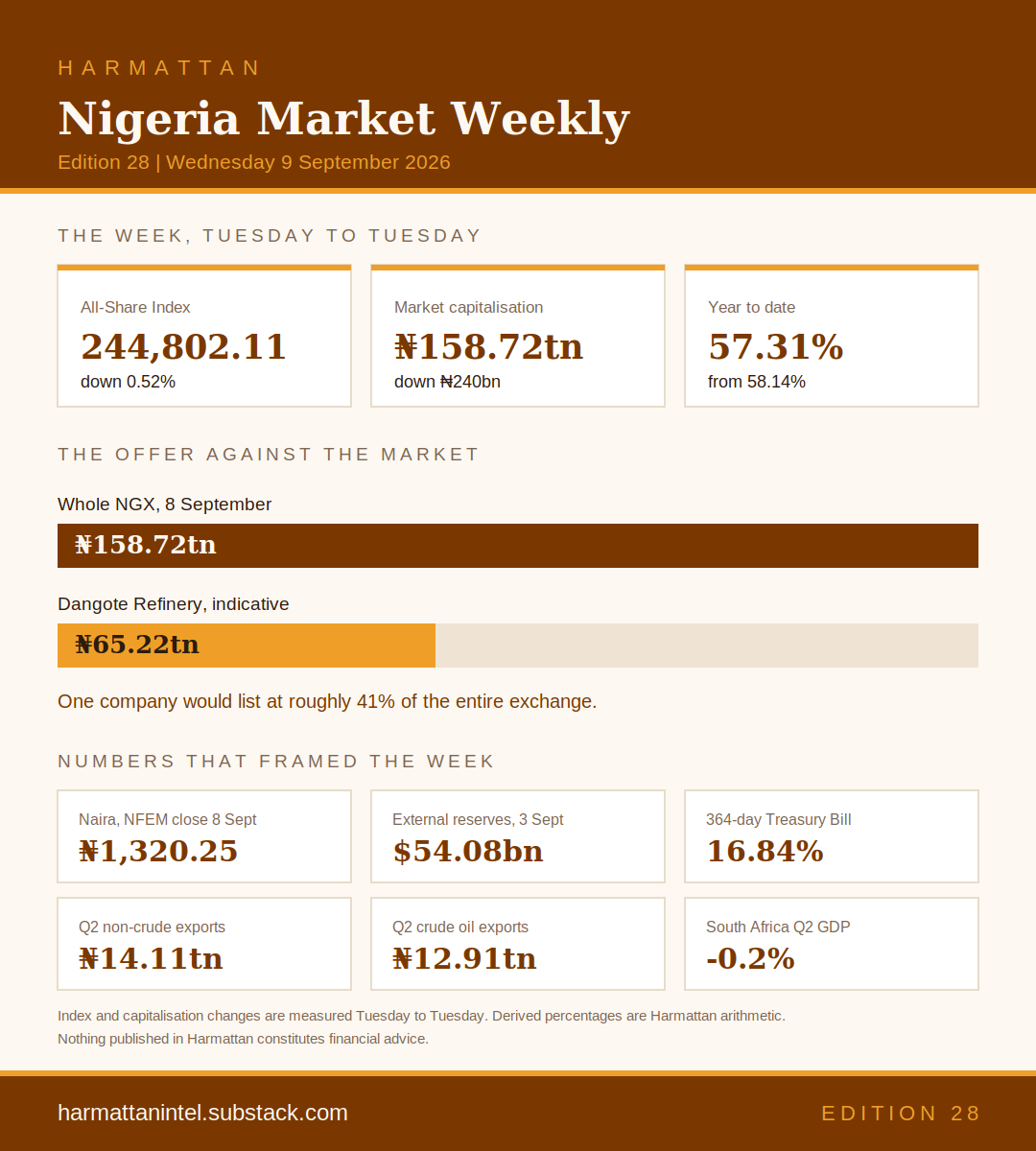
Measured across Harmattan’s Tuesday to Tuesday window, the All-Share Index closed at 244,802.11 on 8 September, down 1,280.52 points or 0.52 per cent from 246,082.63. Capitalisation eased to ₦158.72 trillion from ₦158.96 trillion, about ₦240 billion lighter, and the year to date return slipped to 57.31 per cent from 58.14.
That flatness hides a violent interior. The exchange’s calendar week to 4 September was one of the strongest of the year, the index up 2.36 per cent on turnover of ₦210.3 billion, with Oil and Gas up 9.10 per cent and Insurance, Banking and Consumer Goods all up more than 3.5. On Monday the index added 707.34 points and capitalisation crossed ₦160 trillion, though that crossing leaned heavily on the listing of 8.09 billion new Dangote Sugar Refinery shares, which is fresh paper rather than fresh price, and only twelve stocks rose against forty six that fell. Then Tuesday removed 2,897.67 points and ₦1.88 trillion in one session, on 753.17 million shares worth ₦27.82 billion across 54,051 deals, with exactly four gainers on the entire board: Ellah Lakes at 7.07 per cent, NGX Group at 1.38, Learn Africa at 1.16 and Wema Bank at 0.68. The steepest falls belonged to small companies, AvaCap at 10.00 per cent, Fortis Global Insurance at 9.89 and Abbey Mortgage Bank at 9.74. First HoldCo, down 9.30 per cent, was the only heavyweight among them. The percentage pain sat in the small caps. The index damage sat in the banks and MTN Nigeria. Several outlets have attributed the selling to investors raising cash for the Dangote offer, but no fund flow data has been published and none supports the claim.
₦65.22 trillion. Not one share has traded yet, and the company would arrive on Customs Street worth roughly 41 per cent of everything already listed there.
The Big Story
On Monday at the Eko Hotel in Lagos, Dangote Petroleum Refinery and Petrochemicals signed the documents for an offer of 4.1 billion ordinary shares at ₦525, targeting ₦2.15 trillion, or about $1.63 billion. Subscription opens on 14 September and closes on 13 October, with trading on the exchange expected to begin in late November. The prospectus that came with it is the reason the market stopped arguing about whether the refinery works. Revenue for the six months to June was $13.91 billion, or ₦19.13 trillion, up 121.46 per cent from ₦8.638 trillion a year earlier. Profit after tax was $1.82 billion, against a loss of $476 million for the whole of 2025. Gross profit reached ₦3.432 trillion from ₦225.195 billion. Average utilisation rose to 83.6 per cent from about 45 at the start of the year, and the gross refining margin widened to $24.50 a barrel from $13.70.
The arithmetic that matters to anyone already holding Nigerian equities is not the earnings, though. It is the size. The prospectus registers 120.13 billion existing shares alongside the 4.1 billion on offer, giving an indicative post offer capitalisation of about ₦65.22 trillion. The whole Nigerian Exchange was worth ₦158.72 trillion on Tuesday. CardinalStone Research values the company at ₦77.7 trillion and Chapel Hill Denham at $62.53 billion, both comfortably above the listing price, which is an argument that the offer is cheap and simultaneously an argument that the index is about to be dominated by a single barrel of oil.
For a diaspora investor, the practical question is not whether to subscribe. It is what the NGX becomes afterwards. An exchange whose largest constituent is a refinery is an exchange whose direction is set in the Strait of Hormuz rather than in Abuja. Nigeria has spent 2026 being repriced by index providers, by rating agencies and by its own central bank. From late November it will also be repriced, every trading day, by the crack spread. Institutional allocators who bought Nigeria as a reform story should understand that they are being handed an energy position whether they wanted one or not. Vetiva’s chief executive Chuka Eseka has described the offer as the first in Nigeria that retail investors can subscribe to entirely through digital channels, and the transaction advisers are targeting about ten million subscribers. Whether ten million Nigerians turn up is the real test, and it will be answered in public, in four weeks.
Nigeria’s Money
Two minimum subscriptions landed in the same country in the same week. The Dangote offer will take ₦5,250, being ten shares at ₦525. The Central Bank’s invitation to tender for Wednesday’s Treasury Bills auction, on behalf of the Debt Management Office, sets a minimum bid of ₦50,001,000, in multiples of ₦1,000. The Debt Management Office’s September bond offer carries the identical ₦50,001,000 floor. One instrument is a leveraged industrial asset in a volatile commodity. The other is the sovereign’s own paper, currently clearing at 16.84 per cent on the 364 day bill after two consecutive cuts totalling 75 basis points. Nigerians can buy the risky one for the price of a decent lunch. The safe one begins at fifty million.
This is what financial exclusion actually looks like in a country with a growing market. It is not the absence of instruments. It is the pricing of the door. A saver in Aba or Owerri who wants a government guaranteed 16.84 per cent has to go through a bank or broker willing to aggregate small orders, and whether that happens is a matter of institutional appetite rather than regulation. Meanwhile ₦2.94 trillion of OMO maturities flowed back into the banking system this week, roughly 97 per cent of total projected inflows, money that will be recycled among the same institutions that hold it now. The Dangote offer will introduce more Nigerians to a share certificate in one month than the last decade of financial inclusion conferences managed. That is worth celebrating, and it is also worth asking why the state’s own paper remains the harder thing to buy.
Africa Watch
On Tuesday, Statistics South Africa reported that the continent’s largest economy contracted by 0.2 per cent in the second quarter, its first decline since the third quarter of 2024 and the end of six consecutive quarters of growth. Mining fell 3.0 per cent, trade 1.9 and manufacturing 1.8, while imports surged 4.9 per cent against exports of 0.9. Officials pointed directly at the Middle East conflict and the oil price, and Goldman Sachs cut its full year forecast to 1.2 per cent from 1.6. This matters for anyone who owns Africa as a bloc rather than as a set of countries. The same crude price that pushed Nigeria’s reserves past $54 billion for the first time since December 2008 pushed South Africa into contraction. A single number moved two of the continent’s three largest economies in opposite directions in the same quarter. Diversifying across Africa is not the same thing as diversifying away from oil.
What to Watch
First, the result of Wednesday’s Treasury Bills auction, offered at ₦500 billion, the smallest of the entire third quarter programme and down from the ₦700 billion that has been standard. Watch whether the 364 day rate falls below 16.84 per cent. With ₦2.94 trillion of maturities chasing a shrunken offer, it very likely will, and every basis point makes the equity market and the Dangote offer relatively more attractive to domestic money. Second, 21 September, when Nigeria rejoins the FTSE Frontier series. Vietnam leaves that same index on the same morning, moving up to Secondary Emerging. Vietnam has been the dominant weight in Frontier for years. Its departure changes what every remaining constituent is worth to a passive fund, and no index weight or flow estimate has yet been published by anyone.
Nigeria is about to find out how many of its own citizens will buy a piece of the thing they already fill their tanks from. That answer will tell us more about this market than any index provider can.
Index and capitalisation changes are measured across Harmattan’s Tuesday to Tuesday window rather than the exchange’s calendar week, and all derived percentages and conversions here are Harmattan arithmetic.
Nothing published in Harmattan constitutes financial advice. Always consult a qualified financial adviser before making investment decisions.
Bestman Eleanya
Founder, Harmattan
hello@harmattanintel.com, harmattanintel.substack.com