Edition 22 | Wednesday 29 July 2026
For two years the question of which bank Nigeria values most had only two plausible answers. As of Tuesday evening it has a third, and the two incumbents have not yet been permitted to reply.
That is the strange, compelling shape of this week: a coronation conducted while the evidence file sits sealed on a regulator's desk. Elsewhere, a new exchange that has not yet opened its order book announced it is building a phone.
Market Wrap
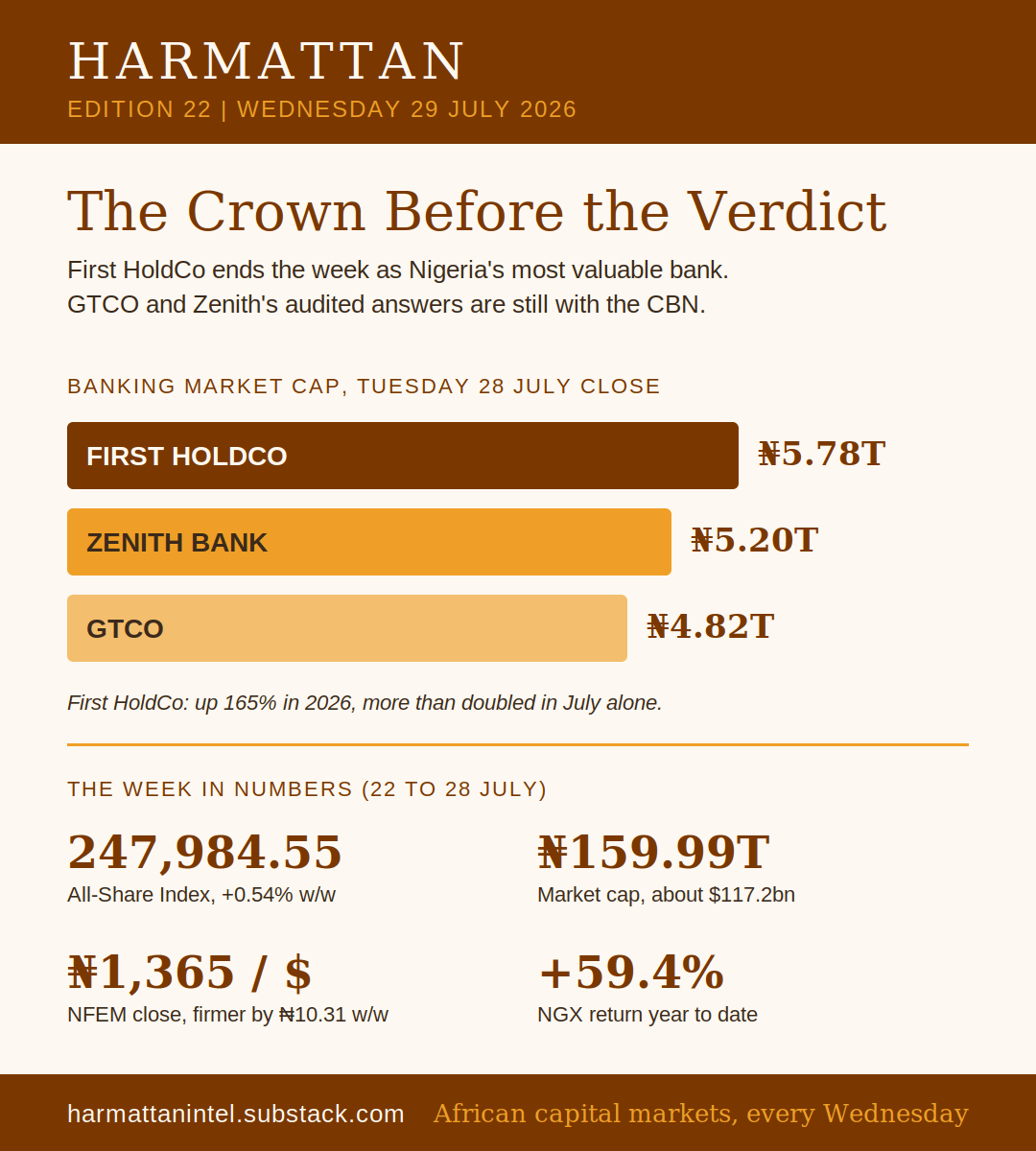
The All-Share Index closed Tuesday at 247,984.55, up 0.54 per cent from last Tuesday's 246,659.56, lifting market capitalisation by roughly ₦870 billion to ₦159.99 trillion, about $117.2 billion, with the year-to-date return now near 59.4 per cent. The modest headline understates a livelier week: Harmattan's Tuesday-to-Tuesday window excludes the July 20 surge already counted in last week's edition, which the NGX's standard Friday week to July 24 retained, so the two measures diverge by construction. The naira, meanwhile, did quiet work of its own, firming to a ₦1,365.00 close at the official window on Tuesday from ₦1,375.31 a week earlier, a gain of ₦10.31, with reserves holding at a 17-year high above $52 billion.
The week's path told the real story. Equity investors surrendered about ₦801 billion on Wednesday, recovered to 247,831.40 on Thursday as First HoldCo touched ₦121 intraday, then watched the Banking Index print an all-time intraday high of 2,605.41 on Friday before profit-taking in the heavyweights trimmed the close. Monday brought earnings-driven divergence, strong filers rewarded and misses punished, and Tuesday finished the window with a 0.30 per cent rise on positive breadth of 36 advancers to 27 decliners. LASACO led Tuesday's gainers, up 10.00 per cent to ₦2.20, ahead of LinkAssure at 9.93 per cent to ₦1.66 and Trans-Nationwide Express at 9.93 per cent to ₦3.10, while Meyer fell 9.97 per cent to ₦16.70, MeCure 9.94 per cent to ₦56.20 and ABC Transport 9.93 per cent to ₦6.35, on turnover of ₦36.40 billion across 676.9 million shares and 55,348 deals.
"₦5.78 trillion. First HoldCo ended the week worth more than any bank on the Nigerian Exchange, and neither of the rivals it displaced has yet published a number in reply."
Dollar figures in this edition use the CBN's NFEM closing rate of ₦1,365.00 on Tuesday 28 July, applied to headline figures only.
The Big Story
GTCO's board met on Tuesday to consider its audited half-year accounts and a possible interim dividend. By the time this edition went to press, nothing had been filed. Zenith's board meets today. This is not evasion; it is plumbing. Audited bank accounts in Nigeria require Central Bank approval before release, and the precedent is sobering: last year Zenith's board approved its half-year accounts on July 24 and the market saw them in September, after an NGX filing extension. The verdicts are coming, but they arrive on the regulator's clock, not the market's.
The market declined to wait. First HoldCo closed Tuesday at ₦127 per share and a market capitalisation of ₦5.78 trillion, decisively ahead of Zenith at ₦5.2 trillion and GTCO at ₦4.82 trillion, capping a run that has seen the stock rise 165 per cent this year and more than double in July alone. What investors are pricing is the one half-year number actually in public view: First HoldCo's record ₦653.5 billion pre-tax profit, up 83.5 per cent, filed unaudited on July 20. Reporting as a holding company with unaudited interim accounts is precisely why its number is public while its audited rivals sit in the approval queue, an asymmetry of timing that has, for now, decided the crown. Femi Otedola underlined his conviction mid-week, adding 706.13 million shares at ₦109.88 on Wednesday, roughly ₦77.6 billion, taking his stake to about 21.95 per cent.
So what must the sealed envelopes contain to change the story? Simple arithmetic, clearly labelled as ours: GTCO earned ₦302.9 billion pre-tax in the first quarter, so overtaking First HoldCo's half-year requires a second quarter above ₦350 billion, a sharp acceleration from the 0.9 per cent year-on-year growth it managed in Q1 against a ₦600.9 billion H1 2025 base. Zenith's first quarter of ₦360.9 billion means a merely flat second quarter would carry it past ₦720 billion and comfortably clear of the new leader on earnings, whatever the market caps say. Two cautions for allocators. First, an interim dividend from GTCO is routine, it paid ₦1.00 for H1 2025, so read the size against that precedent and against First HoldCo's decision to pay nothing on record profits, not the mere fact of payment. Second, First HoldCo's rebound comes off last year's deliberate balance sheet clean-up, which flatters every comparison. The market has ruled first and will examine the evidence later. That is not always a mistake. It is always a risk.
Nigeria's Money
Prof. Ndubuisi Ekekwe spent the week announcing something no Nigerian exchange has attempted: a phone. The ContiSX Phone, unveiled ahead of the exchange's September 24 launch, is pitched as a blockchain-native device with encrypted communications, a built-in AI assistant, and translation across Igbo, Hausa, Yoruba, Pidgin and English, so that an investor can leave instructions for a licensed broker in her own language and have them arrive in his. Most strikingly, the company says no separate data plan is required within its ecosystem. It is a piece of hardware built to answer a question Nigerian finance has dodged for decades: what would the capital market look like if it were designed for the farmer in Bauchi and the trader in Aba rather than retrofitted for them? ContisX's whole architecture leans into that question, from its Owerri headquarters and planned regional centres in Aba, Kano and Ibadan to its stated ambition to bring cooperatives, communities and subnational issuers to market alongside the diaspora.
Seen that way, the phone is not a gadget but a thesis. Nigeria's constraint has never been the absence of money; it is the absence of rails to reach it, and the existing rails carry a double toll of device cost and data cost, priced in dollars, denominated in English. An exchange that removes both tolls at once is attacking exclusion at its root rather than its symptoms, and doing it with the founder's conviction that total investment inclusion means a village should be able to hold FGN bonds as naturally as a Lagos fund manager does. The road from here is demanding, as every genuinely new road is: the device must stay affordable at scale, the free connectivity must hold, and the exchange must open its doors on schedule. But if ContisX delivers even a meaningful fraction of this vision, September will mark more than a launch. It will mark the first time a Nigerian market institution built its front door where most Nigerians actually live. Harmattan will be watching with interest, and with hope.
Africa Watch
Abidjan supplied the week's cleanest signal of continental appetite. Bridge Bank Group Côte d'Ivoire opened subscriptions on July 20 for 20 per cent of its capital, 10 million shares at 6,750 CFA francs for a targeted 67.5 billion CFA francs, about $117 million, and confirmed the next day that the book was fully covered in under 24 hours against a window meant to run into August. The bank, backed by Senegalese billionaire Yérim Sow, is slated to list in early September as the BRVM's sixteenth bank and forty-eighth company, on an exchange whose composite index is up roughly 38 per cent this year. The lesson for Lagos watchers is that the hunger for African bank equity is not a Nigerian peculiarity; it is a continental repricing, and the capital is regional.
What to Watch
Two things. First, the release chain for the sealed bank results: Zenith's board decision today, any interim dividend signals, and crucially the extension notices, because if either lender follows last year's script the audited numbers, and the answer to the banking crown question, may not surface until September. Second, tomorrow's July 30 NGX filing deadline for June half-year accounts, which should deliver a wave of results including MTN Nigeria, coming off a ₦546.4 billion first-quarter pre-tax profit, Access Holdings and Nigerian Breweries, flowing straight into Friday's month-end portfolio rebalancing, a combination that could make the last two sessions of July the most consequential of the month.
Titles change hands quickly in this market; proof moves at the speed of an auditor. Harmattan will be reading the filings the morning they land.
Nothing published in Harmattan constitutes financial advice. Always consult a qualified financial adviser before making investment decisions.
Bestman Eleanya
Founder, Harmattan
hello@harmattanintel.com