

Edition 21 | Wednesday 22 July 2026
Eleven votes, no dissent. The Central Bank of Nigeria’s Monetary Policy Committee emerged from its 306th meeting on Tuesday and did precisely what the market expected: nothing. The benchmark rate stays at 26.50 per cent for a second consecutive meeting, and Governor Olayemi Cardoso’s message was one of patience over panic.
The market, meanwhile, refused to wait for permission. In the two sessions before the committee spoke, Nigerian equities staged one of their most emphatic weeks of the year, powered by a bank that just delivered the best half year in its 132-year history.
Market Wrap
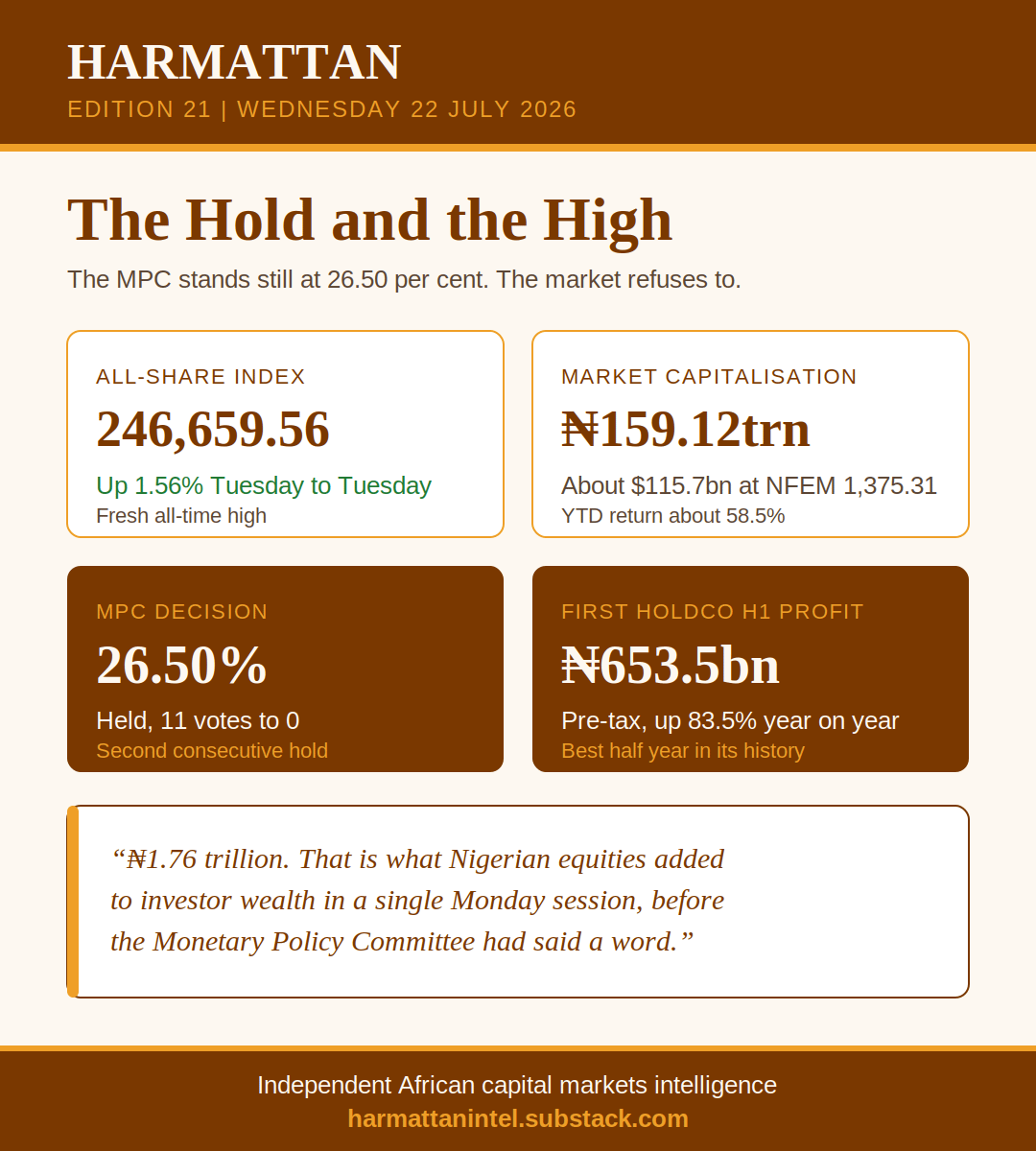
The All-Share Index closed Tuesday at 246,659.56, up 1.56 per cent on our Tuesday-to-Tuesday coverage window from last week’s 242,870.44, and a fresh all-time high. Market capitalisation rose from ₦155.85 trillion to ₦159.12 trillion, roughly 115.7 billion dollars, with the year-to-date return now sitting at about 58.5 per cent. A note on the numbers: the NGX’s own Friday-ended week actually eased 0.14 per cent, but our window captures Monday’s extraordinary session, when the index surged 1.12 per cent and investors added approximately ₦1.76 trillion in paper wealth in a single day. Part of the week’s capitalisation gain also reflects Sterling Financial Holdings’ supplementary listing of 13.8 billion shares rather than pure price appreciation. Dollar figures use the CBN’s NFEM closing rate of ₦1,375.31 on the Tuesday anchor date, applied to headline figures only.
₦1.76 trillion. That is what Nigerian equities added to investor wealth in a single Monday session, before the Monetary Policy Committee had said a word.
The engine was First HoldCo. The stock gained 9.95 per cent on Monday to close at ₦105.50, smashing its previous 52-week high of ₦87.25 after its record results, and the banking index led all sectors with a 3.14 per cent advance while Custodian Investment and NEM Insurance both hit their 10 per cent daily limits and BUA Cement added 9.98 per cent. Tuesday’s session was calmer but still constructive: breadth ran 40 advancers to 22 decliners, UPDC REIT led gainers at 9.86 per cent ahead of Thomas Wyatt at 9.73 per cent and Ikeja Hotel at 9.53 per cent, while MeCure fell 9.95 per cent, HMCALL 9.86 per cent and CMFC 9.85 per cent. Access Holdings was the most active stock with 336.6 million shares traded, and value traded held near ₦49 billion in back-to-back sessions, a sign that the rally is running on genuine liquidity, not thin air.
The Big Story
The hold itself was the least surprising part of Tuesday. What matters is what the committee said, and what it declined to say. Cardoso told the briefing that although headline inflation moderated marginally in June, global uncertainties have heightened, due mainly to renewed hostilities in the Middle East. Beneath the headline number lurks the committee’s real worry: food inflation accelerated to 3.75 per cent month on month in June from 2.98 per cent in May, a reminder that the disinflation story is being carried by base effects and a firmer naira while the price of what Nigerians actually eat is quickening again.
Read properly, this was a hawkish hold. With headline inflation at 15.91 per cent and the policy rate at 26.50, Nigeria is running a real interest rate of more than ten percentage points, among the most restrictive stances of any major emerging economy. A committee confident in its trajectory would have begun trimming that gap. Instead, all eleven members chose to keep the full weight of policy pressing down, citing a war two continents away that could reroute through the Strait of Hormuz into Nigerian petrol prices and freight costs within weeks. The message to anyone pricing an early easing cycle is blunt: the committee wants evidence, not hope.
For investors, the implications cut two ways. High rates keep fixed income yields generous and sustain the interest margins that just produced First HoldCo’s ₦653.5 billion pre-tax half year, an 83.5 per cent leap from the same period of 2025, proof that big-bank earnings power is surviving the fade of the FX windfall era. For the diaspora allocator, the hold also underwrites the naira: the currency firmed to ₦1,375 at the official window through decision week and reserves climbed to $52.02 billion, meaning the carry trade that has quietly rewarded dollar-based investors all year remains intact. The cost is borne elsewhere, by every borrower still paying 30-plus per cent for working capital.
Nigeria’s Money
Here is the awkward truth beneath Tuesday’s decision: the committee’s 26.50 per cent applies to money inside the banking system, and most Nigerian cash never goes there. The CBN’s latest money and credit statistics show ₦5.19 trillion held outside banks as of May, some 91.27 per cent of the ₦5.69 trillion in circulation, meaning more than nine out of every ten naira notes sit with households, traders and the informal economy rather than in a vault. Monetary policy in Nigeria is a lever connected to perhaps a tenth of the nation’s physical money. The other nine tenths answer to the market woman’s cash box, the ajo collector’s ledger and the mattress.
The Bank knows it. In June, Cardoso launched the Payments System Vision 2028, pledging to cut cash outside banks from about 90 per cent to below 40 per cent by 2028, an ambition worth roughly ₦2.83 trillion in deposits migrating into the formal system. The timing is not accidental: MPC members have warned that cash-heavy campaign spending ahead of the 2027 elections could undermine disinflation gains. For readers, the investment logic is direct. Whichever institutions build the rails that finally move that ₦5.19 trillion, the agent networks, the mobile wallets, the low-friction savings products, will be intermediating the largest untapped deposit pool in West Africa. The record highs on Customs Street are being set in a country where most money has never met a broker.
Africa Watch
Africa’s most anticipated fintech listing is moving again. Airtel Africa is adding investment banks to the syndicate for its Airtel Money IPO, now firmly pointed at London in the second half of 2026 at a valuation of around $10 billion, with Citigroup leading and proceeds of $1.5 to $2 billion targeted. The business earned $1.36 billion in revenue in its latest financial year and serves 54.1 million customers, yet only 2.7 million of them are in Nigeria, a statistic that says as much about Nigeria’s unfinished mobile money story as it does about Airtel’s. If it prices at ambition, this becomes London’s biggest listing in half a decade, and a landmark repricing of African financial infrastructure in global portfolios.
What to Watch
Two things this week. First, the earnings wave: with First HoldCo’s early print already on the tape and no interim dividend attached, attention shifts to GTCO’s board meeting on 28 July and Zenith’s on 29 July, with at least 18 major filers due before month end. Watch the payout signals as closely as the profits; CSCS has already declared the first interim dividend in its history, and if the big banks follow with cash rather than capitalisation, it marks a new phase of the recapitalisation era. Second, the naira: it strengthened into and through the MPC decision, closing decision day at ₦1,375.31 with reserves above $52 billion. If the official rate holds below ₦1,380 in the days after the hold, it confirms the CBN has the FX room to make its patience credible.
The committee chose stillness; the market chose motion. Both, in their way, are bets on the same thing: that Nigeria’s numbers are finally becoming boring enough to trust. Harmattan will be watching which side blinks first.
Nothing published in Harmattan constitutes financial advice. Always consult a qualified financial adviser before making investment decisions.
Bestman Eleanya
Founder, Harmattan
hello@harmattanintel.com
harmattanintel.substack.co
m