

Harmattan | Edition 23 | Wednesday 5 August 2026
For most of this year, the Nigerian market has behaved like a tide, lifting everything that floats. This past week it started behaving like a jury. Four of the five sessions closed red, the gains that did come were concentrated in a handful of names, and the stocks that fell hardest were the ones with the least earnings evidence behind them. That is not a market losing faith. It is a market starting to keep score.
Market Wrap
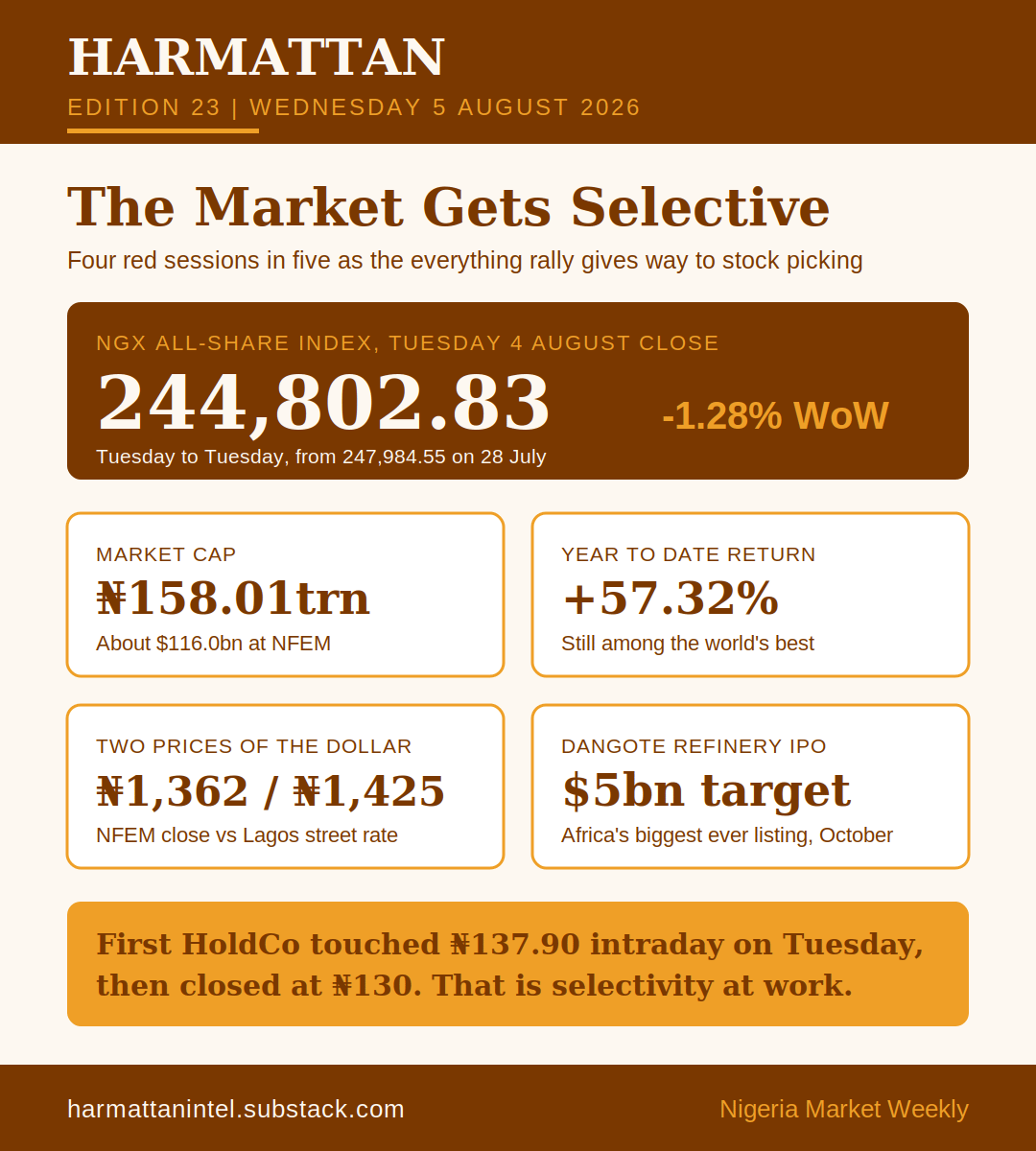
The All-Share Index closed Tuesday at 244,802.83, down 1.28 per cent from the prior Tuesday’s 247,984.55, a figure derived from the two closes. Market capitalisation ended at ₦158.01 trillion, roughly ₦1.98 trillion lighter than a week earlier by the same arithmetic, and worth about $116.0 billion in dollar terms. The retreat was steady rather than violent: three consecutive declines carried over from late July, Monday interrupted with a 0.18 per cent rise led by banking names, and Tuesday resumed the slide with a 0.38 per cent drop. Only Monday’s session finished green all week. The year-to-date return now stands at 57.32 per cent, still among the strongest returns of any equity market on earth, and July as a whole delivered a 6.92 per cent gain even after the late-month selling. Dollar figures use the CBN NFEM closing rate of ₦1,362.55 on Tuesday 4 August, applied to headline figures only. Harmattan measures its week Tuesday to Tuesday; the NGX’s own Friday-to-Friday scorecard for the week ending 31 July printed a smaller 0.84 per cent decline, and this window also contains the July month end, which is why the two figures differ.
Tuesday’s session told the week’s story in miniature. AVA Capital led the gainers at 9.94 per cent to ₦9.95, still finding its price after listing five billion shares in late July, followed by Chapel Hill Denham’s Nigeria REIT at 9.71 per cent and Livestock Feeds at 9.49 per cent. LivingTrust and Multiverse both hit the 10 per cent downward limit, with McNichols close behind at 9.92 per cent. Turnover came to 1.56 billion shares worth ₦28.73 billion across 54,160 deals, with Japaul Gold dominating volume and MTN Nigeria leading value. Note that the recent listings by AVA Capital and Fortis Global Insurance added new paper to the market during the window, so the fall in capitalisation slightly understates the price declines beneath it.
“₦137.90. First HoldCo touched a fresh high on Tuesday and closed at ₦130 by the bell, which is what a market that has stopped buying everything looks like.”
The Big Story
The largest initial public offering in African history moved from ambition to timetable this week. Reporting sourced to people with knowledge of the plan puts the Dangote Petroleum Refinery’s offer at about $5 billion, with the process expected to conclude around October, and the primary listing set for the Nigerian Exchange. Then came something remarkable: the chief executive of the Johannesburg Stock Exchange went on record courting a secondary listing once the Lagos debut is done, and exchanges in Kenya, Egypt, Ghana and Rwanda are reportedly circling the same prize. Africa’s largest bourse is publicly bidding for a slice of a Nigerian asset. That sentence would have been unthinkable a decade ago.
The mechanics matter as much as the headline. The NGX main board ordinarily requires a 20 per cent free float, though exceptions exist; Dangote Cement trades on a float of just under 13 per cent. Other African exchanges wanting exposure would likely need structured routes, depositary receipts or exchange-traded instruments mirroring the Lagos shares. The valuation debate will be fierce. Turkey’s Tupras, with comparable refining capacity across four plants, carries a market value near $12 billion; HF Sinclair in New York, with similar capacity, sits around $16 billion. A 650,000 barrel per day single-site refinery that has spent the past two years selling jet fuel into Europe will test where global investors place a Nigerian industrial asset on that spectrum.
For the diaspora investor, this is the clearest route yet into Nigeria’s energy transformation through a regulated public market, potentially across multiple venues. For the NGX, a listing of this scale would reorder the index and deepen the market precisely when the FTSE Russell assessment process has put Nigerian market plumbing under a microscope. One caution belongs on the record: Dangote listing timelines have slipped before, and October should be read as intent, not promise. But intent backed by appointed advisers and competing exchanges is a different species of intent.
Nigeria’s Money
There are two prices for the dollar in Nigeria this week, and the gap between them is quietly widening. The official NFEM rate closed Tuesday at ₦1,362.55, barely moved all week inside a narrow band. On the streets of Lagos, traders were buying dollars at about ₦1,410 and selling between ₦1,415 and ₦1,425. That is a spread of roughly ₦50 to ₦60, around 4 per cent, and it has grown from about ₦40 a week earlier even as the official rate held firm.
That 4 per cent is not an abstraction. It is what the informal economy pays to touch a dollar: the recipient cashing a remittance outside the banking system, the trader funding small imports below documentation thresholds, the household keeping savings in physical notes. Reserves above $52 billion and a stable official rate tell one story about Nigeria’s external position. The street price tells another, about where that liquidity does not reach and who pays the toll for standing outside the formal system. A widening spread against a calm official market is worth watching, because it measures demand the official window is not meeting.
Africa Watch
Nigeria lost a crown this week, and to an unlikely rival. Zimbabwe ended July as Africa’s best-performing equity market in dollar terms, with the Zimbabwe Stock Exchange returning 68.5 per cent year to date against the 17 exchanges tracked by African Markets, overtaking Nigeria after months of gains built on easing inflation, a steadier local currency and renewed domestic appetite for shares. The caveat writes itself: Harare rallies have historically doubled as inflation hedges, and dollar returns there can evaporate as quickly as they compound. Still, the broader signal is real. African equities are having a generational year, and the competition at the top of the table now runs deeper than one market.
What to Watch
Two things matter in the days ahead, and neither of them is the bank results wait, which Harmattan has flagged twice already and will treat as news on the day it becomes news. First, the August dividend qualification window: eight listed companies have qualification dates falling this month, according to corporate disclosures filed with the NGX, from University Press at ₦0.18 with a 28 August cutoff onwards. Under the T+1 settlement cycle in force since June, the same one-day regime FTSE Russell is currently assessing, an investor needs to buy just one trading day before the qualification date to make the register, and in a market that has turned selective, dividend capture flows tend to show up visibly in exactly these names in the sessions before each cutoff. Second, the NBS July inflation reading, expected mid-month, the first price data of the second half. Whether the disinflation trend extended into July decides how much room the MPC has when it meets in September, and it will shape how investors price every fixed income auction between now and then.
The market spent eighteen months rewarding presence. It has started rewarding proof. Harmattan will be here every Wednesday, keeping score alongside it.
Nothing published in Harmattan constitutes financial advice. Always consult a qualified financial adviser before making investment decisions.
Bestman Eleanya
Founder, Harmattan
hello@harmattanintel.com
harmattanintel.substack.co
m