Edition 32 | 7 October 2026
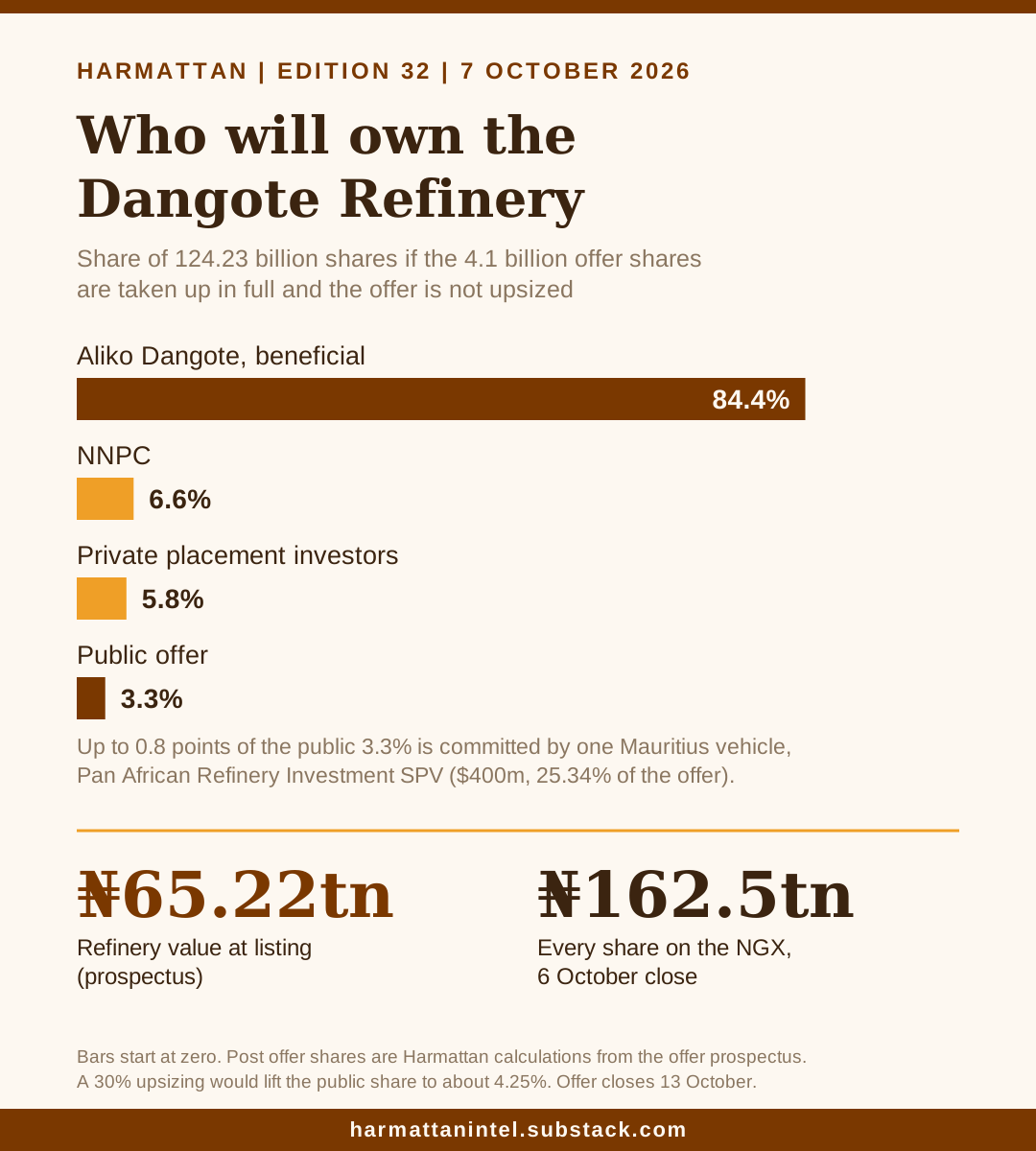
The Dangote Petroleum Refinery offer closes on Tuesday. The entry price, ten shares for ₦5,250, has had most of the attention. The prospectus says more about what those shares buy. It values the refinery at ₦65.22 trillion at listing. It shows Aliko Dangote still owning about 84 per cent of the company once the offer is done. And it records that one investment vehicle registered in Mauritius has committed to take up to a quarter of the shares on sale.
The market, meanwhile, drifted lower in all four sessions of a week shortened by Independence Day.
Market Wrap
The All Share Index ended Tuesday at 250,273.50, down 0.65 per cent from 251,913.20 a week earlier. Capitalisation finished at ₦162.5 trillion, against ₦163.53 trillion. In dollars, at the Central Bank’s weighted average rate of ₦1,330.87, the market was worth about $122.10 billion, down from $122.91 billion. The naira barely moved and gross reserves rose $63 million to $54.98 billion. The index remains up 60.83 per cent on the year.
The banks dominated Tuesday’s 579.25 million shares, worth ₦36.07 billion across 41,072 deals. Access Holdings traded ₦5.78 billion, Zenith Bank ₦4.18 billion and GTCO ₦2.59 billion. Tripple Gee rose 9.77 per cent to ₦2.81, Livestock Feeds 9.74 per cent to ₦10.70 and NPF Microfinance Bank 9.52 per cent to ₦4.60. Critical Minerals Financing Corporation fell 9.88 per cent to ₦3.65, ABC Transport 9.70 per cent to ₦6.05 and CWG 7.23 per cent to ₦19.25. The Central Bank sold ₦3.31 trillion of its own short term OMO bills against ₦2.17 trillion maturing.
₦65.22 trillion. The value the Dangote Refinery prospectus places on the company at listing. On Tuesday, every share on the NGX together was worth ₦162.5 trillion.
The Big Story
The prospectus states that Aliko Dangote is the beneficial owner of 87.27 per cent of the refinery’s 120.13 billion existing shares, held through Dangote Oil Refining Company, Dangote Industries and Greenview International Corporation. The Nigerian National Petroleum Company holds 6.8 per cent and the investors in a $2.5 billion private placement completed in June and July hold 5.95 per cent. The offer adds 4.1 billion new shares. Taken up in full, it leaves Mr Dangote with about 84.4 per cent and puts 3.3 per cent of the company in public hands. If the offer is oversubscribed the issuer may absorb up to 30 per cent more, with Securities and Exchange Commission approval, lifting that to about 4.25 per cent.
Part of that slice is already spoken for. Pan African Refinery Investment SPV, a Mauritius vehicle formerly called India Infra Buildco, committed on 28 August to subscribe for up to the naira equivalent of $400 million, about 1.04 billion shares or 25.34 per cent of the offer, under the same allotment rules as every other applicant. The prospectus does not say who stands behind it. The offer is not underwritten. Small applicants have some protection: valid applications below a full allotment threshold, still to be set, will be filled in full.
At ₦65.22 trillion the refinery would be worth about two fifths of everything listed on the NGX at Tuesday’s close, or about $49 billion. A company that large with so few shares in public hands raises a liquidity question before a valuation one, and the prospectus says so itself: liquidity “may be affected by a number of factors, including the number of Offer Shares available for public trading”. How heavily it will count in the All Share Index depends on whether the index weights every issued share or only those that trade, a question the NGX should settle before trading starts, which the indicative timetable puts in early December. The business has turned: after losses of $1.51 billion in 2024 and $475.8 million in 2025, the refinery earned $1.82 billion after tax in the first half of 2026.
For a diaspora investor, two further details matter. The company intends to declare dividends in dollars, though it may pay them in naira, and its financing agreements can restrict payouts. And the ₦2.11 trillion of net proceeds, about $1.59 billion, covers roughly 11 per cent of the $14.3 billion expansion it is meant to fund. A buyer at ₦525 is taking a small minority stake in a company controlled by its founder, whose dividend will compete with a five year building programme.
Nigeria’s Money
The Central Bank’s own money market table puts the savings deposit rate at 7.32 per cent in June, 7.36 per cent in July and 7.46 per cent in August. Throughout those months the policy rate was 26.5 per cent, and the Central Bank’s rule requires banks to pay at least 30 per cent of it on savings, which was 7.95 per cent. The reported rate sat below the floor in every one of those months.
The table does not explain how its figure is built, so this is Harmattan’s interpretation: if it is an industry average, some banks were paying less than the minimum. August inflation was 15.39 per cent, almost 8 percentage points above the reported savings rate. The floor is now 6.9 per cent, and the same test applies. The Central Bank publishes the rule and the rate. It does not publish which banks pay below the rule, and that list would do more for ordinary savers than any further cut.
Africa Watch
Kenya’s Monetary Policy Committee held the Central Bank Rate at 8.75 per cent on Wednesday, its fourth consecutive hold since a cut in February. Inflation rose to 6.8 per cent in September from 6.6 per cent, nearer the 7.5 per cent ceiling of its target range. Average lending rates edged up to 14.4 per cent while private sector credit grew 10.6 per cent. The Central Bank of Kenya credits its risk based credit pricing model, fully in force since March, with improving how policy reaches borrowers. That is the instructive part for Nigeria, whose central bank has named the NOFR, an overnight rate built from actual transactions, as its benchmark. Kenya shows the next step: loan pricing tied to a benchmark by rule.
What to Watch
First, the result of today’s Treasury bill auction, the first of the quarter, where ₦700 billion of the ₦900 billion on offer is one year paper. That bill cleared at 15.89 per cent on 23 September. A lower stop rate would show government borrowing costs following the reset; a higher one, buyers wanting more for longer money. Second, what follows Tuesday’s close of the Dangote offer. The basis of allotment is due at the SEC on 5 November, and it will show whether the 30 per cent upsizing is used and how much of the Mauritius commitment is filled.
A prospectus is written under legal liability, which makes it worth more than any advertisement. This one tells Nigerians plainly what is for sale: a small piece of a very large company, run by the man who built it. That is worth knowing before Tuesday.
Correction: Edition 31 stated that ₦497.59 billion was allotted against a ₦500 billion offer at the 23 September Treasury bill auction. The Central Bank’s results table shows ₦600 billion offered, including ₦400 billion of the one year bill, and ₦497.58 billion allotted.
Tuesday to Tuesday changes, dollar conversions, post offer ownership shares, the refinery’s size relative to the NGX and the early December listing estimate are Harmattan calculations, using NGX closing figures, Central Bank of Nigeria weighted average exchange rates and the offer prospectus.
Nothing published in Harmattan constitutes financial advice. Always consult a qualified financial adviser before making investment decisions.
Bestman Eleanya
Founder, Harmattan
hello@harmattanintel.com; harmattanintel.substack.com