Edition 34 | 21 October 2026
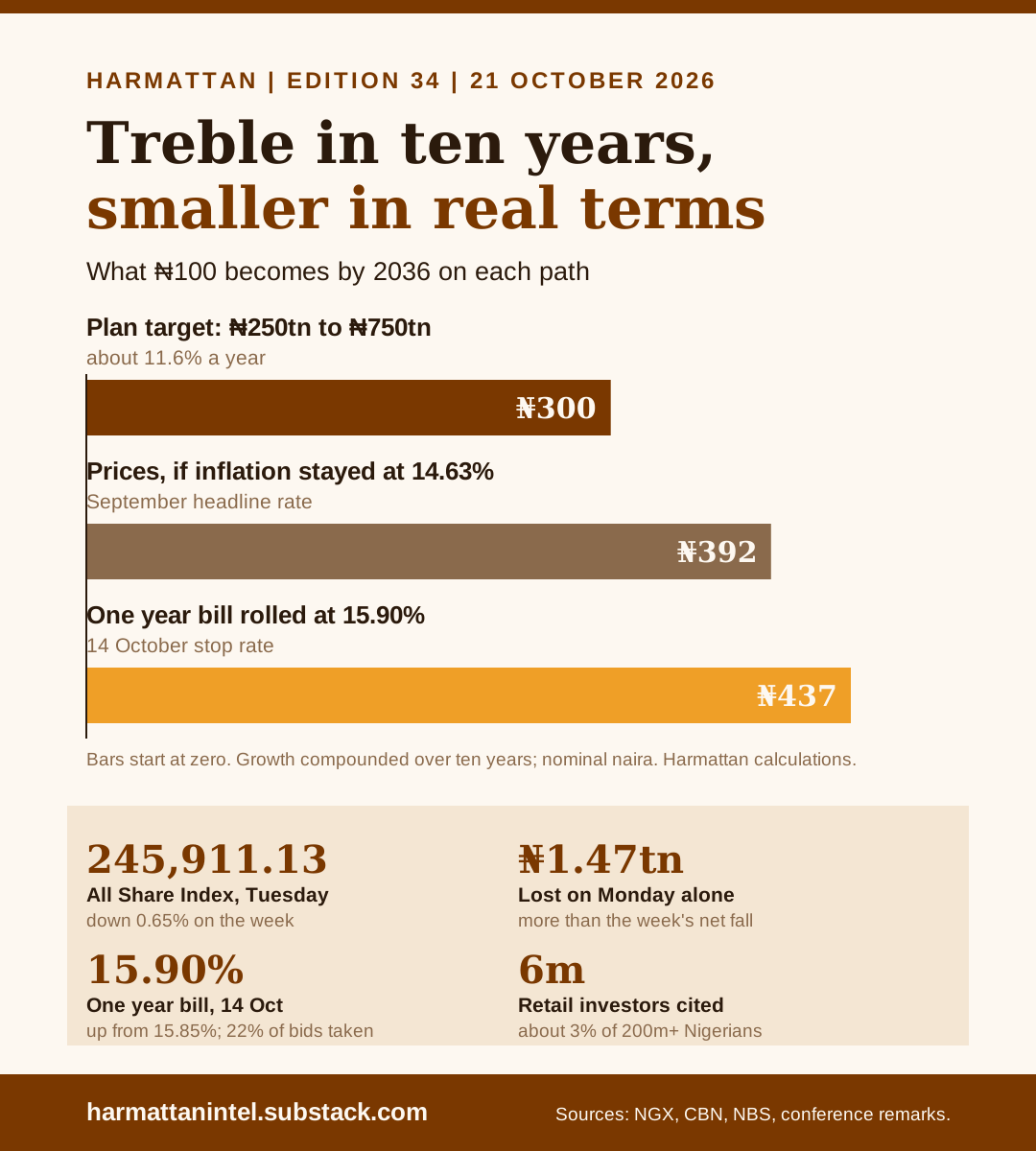
On Monday, at the Presidential Villa in Abuja, the government launched a ten year plan to treble the size of Nigeria’s capital market. The same day, the stock market lost ₦1.47 trillion, more than it lost across the whole week. One did not cause the other. Side by side, they show how much work a naira target must do before it means anything.
Market Wrap
The All Share Index closed Tuesday at 245,911.13, down 0.65 per cent from 247,513.63 a week earlier, and capitalisation fell by the same margin to ₦159.67 trillion. Monday carried the week. The index dropped 0.91 per cent, and Dangote Cement’s 5.50 per cent fall to ₦1,008 accounts for roughly two thirds of the ₦1.47 trillion lost. The other four sessions together edged higher. In dollars, at the Central Bank’s weighted average rate of ₦1,333.65, equities were worth about $119.72 billion, against $120.56 billion a week earlier, and the index is up about 58.0 per cent this year.
The five sessions turned over about 1.56 billion shares. Austin Laz led Tuesday’s gainers, up 9.97 per cent to ₦3.53, ahead of ABC Transport at 9.92 per cent and Cutix at 9.91 per cent. Livestock Feeds fell 9.76 per cent to ₦17.10, Guinea Insurance 7.78 per cent and NPF Microfinance Bank 5.75 per cent. In the exchange’s week to Friday, 50 stocks rose and 30 fell, yet the index slipped 0.33 per cent while the banking index lost 3.15 per cent. Breadth counts how many stocks moved; the index weighs how heavy they were. On 14 October the government sold ₦269.06 billion of the ₦450 billion of bills it offered. The one year bill cleared at 15.90 per cent, up from 15.85 per cent, and the Central Bank accepted only about 22 per cent of the ₦982.21 billion bid for it.
11.6 per cent. The yearly growth the new master plan needs to reach ₦750 trillion by 2036, below September’s inflation rate of 14.63 per cent.
The Big Story
The Nigerian Capital Market Master Plan 2.0 runs from 2026 to 2036. Emomotimi Agama, director general of the Securities and Exchange Commission, said it would grow the market from a baseline of about ₦250 trillion to ₦750 trillion. The plan itself has not been published, so whether that baseline means equities alone or equities and bonds together cannot yet be confirmed. Taiwo Oyedele, the finance minister, added two targets of a different kind: equity market value rising from 33 per cent of GDP to at least 60 per cent, and an investment grade credit rating within three years. He also spoke of a $1 trillion market, which reports treat as his proposal rather than a target in the plan.
Start with the arithmetic. Trebling in ten years is growth of about 11.6 per cent a year, in naira. September’s headline inflation was 14.63 per cent. If prices kept rising at that pace for a decade, a market that hit ₦750 trillion exactly would be smaller in real terms in 2036 than it is today. A saver who rolled a one year Treasury bill at last week’s 15.90 per cent every year would more than quadruple her naira over the same period. In dollars, ₦750 trillion is about $562 billion at Tuesday’s rate, little more than half the minister’s $1 trillion. Our reading is that the naira headline is the least demanding number in the plan. The share of GDP target is the serious one, because it can only be met if the market grows faster than the economy it measures, whatever inflation does to both.
The launch also carried a claim that needs checking. The speech delivered on the vice president’s behalf said the All Share Index had risen to more than 260,000 points. On the day it was read, the index closed at 245,278.34, almost 15,000 points short, and no close in the exchange figures Harmattan has tracked this year comes near 260,000. That matters because Mr Agama promised that every commitment in the plan would have an owner, a timeline and a scorecard. A scorecard is only as good as its starting line. For a diaspora investor or an allocator weighing Nigeria over ten years, the useful questions are the measure behind ₦250 trillion, the share of GDP in each annual report, and whether progress is stated in real terms. A plan reported only in naira totals will look like success in almost any decade.
Nigeria’s Money
Mr Agama was blunt about the gap the plan has to close. “Our market is growing in value; it is not yet growing deep enough in people,” he said, adding that much of Nigeria’s savings sits outside the formal system, losing value to inflation. Mr Oyedele put a number on it: about six million retail investors in a population of more than 200 million, roughly 3 per cent. He said the new National Savings Scheme would take small contributions by mobile phone.
That is the right channel, and it meets a strong rival. The trader in Balogun or the farmer in Benue already saves, often daily, with an ajo or esusu collector who is paid for keeping her money and hands it back in cash when she needs it. September’s core prices rose 1.11 per cent in a single month, about 14 per cent at an annual pace, so idle money loses. The scheme wins her savings only if it costs less than the collector and pays out as fast. The minister promised reasonable costs. The fee is the number to wait for.
Africa Watch
Kenya’s Treasury bill auction on 15 October showed money staying short. Investors bid KSh49.80 billion for the 91 day bill against KSh8 billion offered, and the Treasury accepted KSh34.24 billion, more than four times its offer, at an average of 8.75 per cent, the same as the Central Bank of Kenya’s policy rate. The one year bill drew only KSh6.64 billion for KSh10 billion on offer and cleared at 9.04 per cent, barely changed. In Lagos, investors bid nearly three times the one year offer and the Central Bank turned most of it away; Kenyan investors would not fill a one year offer that paid less than 0.3 percentage points more than three month paper. The auction alone cannot say whether Nairobi expects rates to stay put or simply wants cash close.
What to Watch
First, the Dangote Petroleum Refinery offer closes on Tuesday 27 October. Its terms allow up to 30 per cent more shares, about 1.23 billion worth ₦645.75 billion, with the Securities and Exchange Commission’s approval; whether that option is used will decide how far applicants are scaled back. Second, the Treasury bill auction on Wednesday 28 October, with ₦800 billion on the calendar after ₦392.79 billion of bills matured today unreplaced. A second rise in the one year rate would make last week’s look less like noise and more like a direction.
Ten years is long enough for a target to be met and still leave savers poorer. The measure that will matter in 2036 is how many Nigerians own a piece of their own market, and that number is worth counting from now.
Correction: Edition 33 reported ₦21.38 billion traded on 13 October, from press reports. The NGX weekly report gives ₦21.35 billion in 38,660 deals.
Tuesday to Tuesday changes, five session volume, dollar conversions, year to date return, Dangote Cement’s share of Monday’s loss, the plan’s implied growth rate and its real and dollar equivalents, the compounded bill return, core inflation at an annual pace and auction acceptance ratios are Harmattan calculations, using NGX closing figures, Central Bank of Nigeria weighted average exchange rates and auction results, Central Bank of Kenya auction results and figures stated at the conference.
Nothing published in Harmattan constitutes financial advice. Always consult a qualified financial adviser before making investment decisions.
Bestman Eleanya
Founder, Harmattan
hello@harmattanintel.com; harmattanintel.substack.com