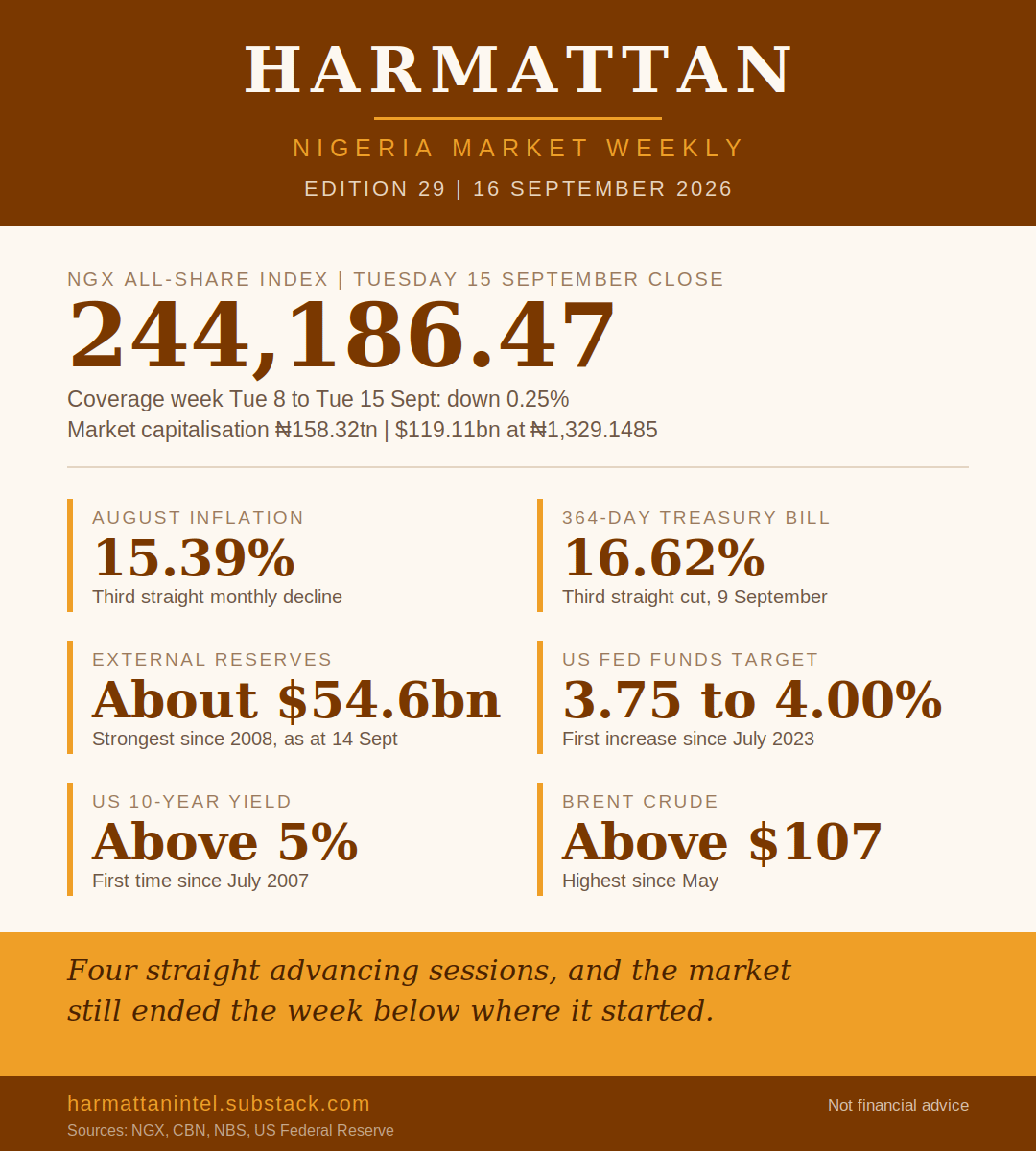
Edition 29 | Wednesday 16 September 2026
For three years the story of Nigerian interest rates has been a story about somewhere else. Rates rose in Washington, capital left Lagos, and the Central Bank of Nigeria raised to keep what was left. This week that sequence came apart. The US Federal Reserve raised its policy rate on Wednesday for the first time since July 2023, taking the target range to 3.75 to 4.00 per cent on a unanimous twelve to nothing vote, and the US ten year Treasury yield crossed 5 per cent on Tuesday for the first time since July 2007. Nigeria spent the same seven days walking the other way. The 364 day Treasury bill cleared at 16.62 per cent on 9 September, a third consecutive cut, and inflation eased for a third straight month to 15.39 per cent.
Two central banks, two directions, one week. What lifts it above curiosity is where the money is coming from. The oil price forcing the Fed’s hand is the same oil price filling Nigeria’s reserves, and both things reached a threshold in the same seven days.
Market Wrap
The coverage week closed almost exactly where the arithmetic says it should have. Measured from the Tuesday 8 September anchor of 244,802.11 to Tuesday 15 September’s 244,186.47, the All Share Index gave up 615.64 points, or 0.25 per cent, while capitalisation slipped from ₦158.72 trillion to ₦158.32 trillion, also 0.25 per cent. Those two numbers matching is not a coincidence and it is worth pausing on, because they did not match the week before, when the index fell 1.60 per cent against capitalisation down 1.24 per cent. That earlier gap was supply. NGX Regulation admitted 8,097,918,827 new Dangote Sugar Refinery shares to the daily official list on Monday 7 September, lifting issued capital to 20,244,797,068 from 12,146,878,241. No such listing fell inside 8 to 15 September, so this week the two measures moved as one.
“244,186.47. Four straight advancing sessions, and the market still ended the week below where it started.”
The path matters more than the destination. Wednesday 9 September was the low at 242,223.10, down 1.05 per cent. Then four consecutive advances, 0.06 per cent, 0.28 per cent, 0.10 per cent and 0.36 per cent, recovering 1,963.37 points and ₦1.27 trillion of capitalisation without quite reaching the starting line. Tuesday’s session was led by NGX Group, up 9.95 per cent to ₦179.00, Aradel Holdings up 9.62 per cent to ₦1,550.00 and Sovereign Trust Insurance up 9.50 per cent to ₦1.96. Ecobank Transnational fell the full 10.00 per cent to ₦66.65, Tranex Nigeria lost 9.93 per cent to ₦2.45 and AVA Capital 9.90 per cent to ₦4.55, with PZ Cussons close behind at 9.52 per cent. Turnover was 505.11 million shares worth ₦36.28 billion across 71,635 deals, with GTCO trading ₦4.86 billion and Zenith ₦3.93 billion among the most active names. Year to date the market stands at 56.92 per cent, down from 57.31 per cent a week earlier. In dollars the week reads harder than in naira. At the CBN weighted average rate of ₦1,329.1485, Tuesday’s capitalisation was $119.11 billion against $120.22 billion at the anchor, a fall of about $1.11 billion or 0.92 per cent, because the currency gave back ₦8.90 over the same seven days after its strongest run in two years.
The Big Story
Nigeria’s external reserves quietly passed a number the market has been watching all month. CBN data put gross reserves at about $54.6 billion as at 14 September, up from $54.08 billion on 3 September. Every Nigerian outlet covering the climb has used 22 December 2008 as the reference point, when reserves stood at roughly $54.21 billion, and by that measure the barrier is now behind us. It is worth being precise about what that does and does not mean. December 2008 was not the peak. Nigeria's gross reserves peaked at $64.85 billion on 8 August 2008 and were already well into the post crisis drawdown by Christmas. So this is the strongest external position in eighteen years and roughly $10.2 billion short of the all time high, which is a different and more useful sentence than the one currently circulating.
The mechanism is not mysterious. Brent closed at $107.63 on Thursday 10 September after a 6.3 per cent single session move and stayed above $107 through the following week, supported by the shutdown of Saudi Arabia’s East West pipeline and continued disruption around the Strait of Hormuz. Nigeria sells crude into that. The same shock reaches the United States as an inflation problem rather than a revenue one, which is why the ten year Treasury yield has risen for five straight sessions and why BMO now measures the one month correlation between crude and the ten year at 0.96, the tightest since June 2019. For a country that exports the commodity and imports the capital, those two effects arrive on opposite sides of the ledger at the same moment.
For an allocator the practical question is which effect dominates over the next six months. The case for Nigeria has been built on a falling policy rate, a stabilising currency and index reinstatement bringing benchmark driven buyers back. Two of those three are intact. But the hurdle has moved. When the risk free rate in dollars was 4 per cent, a frontier equity market compounding at 57 per cent a year in local currency was an easy conversation. At 5 per cent, with the Fed’s own projections showing sixteen of eighteen participants expecting another increase this year, the conversation gets harder, and it gets harder precisely as Nigeria cuts its own yields into it. A diaspora investor funding a naira position from abroad should understand that they are now being paid less to take Nigerian duration while being offered more to take none at all.
Nigeria’s Money
The August inflation print is accurate and it is already out of date. Headline eased to 15.39 per cent from 15.43 per cent in July, with month on month inflation falling sharply to 0.71 per cent from 1.57 per cent and monthly food inflation collapsing to 1.02 per cent from 5.56 per cent. Then look at what happened after the month closed. Dangote Petroleum Refinery raised its gantry price to ₦1,350 a litre on 12 September, the fourth increase since late August and ₦185 or 15.9 per cent above the ₦1,165 the sequence began at. MRS stations moved to ₦1,400 from ₦1,300, NNPC outlets to ₦1,375 from ₦1,275, and by Tuesday 15 September NNPC stations across Abuja were selling between ₦1,395 and ₦1,430. Marketers have attributed the moves to crude above $100 and rising costs through the supply chain. Whatever the cause, August’s number describes a month that ended before any of it.
There is a second divergence inside the same release, and it is the one that should trouble anyone reading the headline as relief. Urban month on month inflation was 0.28 per cent in August. Rural month on month inflation was 1.79 per cent, up from 0.78 per cent in July. The disinflation is concentrated in the cities. In the villages prices accelerated, and they accelerated before the petrol sequence reached the pumps, which is where rural transport costs eventually show up. Nigeria is currently being invited to buy shares in the company setting the gantry price. Both things can be true at once, and the reader deciding whether to subscribe deserves to hold them together rather than separately.
Africa Watch
The BRVM published notice number 263-2026 on Tuesday 8 September admitting Bridge Bank Group Côte d’Ivoire to the main compartment of its equity market from 24 September under the ticker BBGC, at a reference price of CFAF 6,750. The offer behind it is the interesting part. Bridge Bank sought CFAF 67.5 billion for 20 per cent of its capital, drew CFAF 95.8 billion in orders, closed inside twenty four hours against an eighteen day window, and brought 17,544 investors onto its register. It becomes the sixteenth bank and forty eighth company on an exchange serving eight countries where new listings remain rare. Set that 17,544 against the roughly ten million retail subscribers Nigerian advisers are targeting for a single offer and the difference in market depth across West Africa becomes concrete rather than theoretical.
What to Watch
Two dates, and they are one working day apart. FTSE Russell’s reclassification takes effect after the close on Friday 18 September for the open on Monday 21 September, and as at today neither FTSE Russell nor the NGX has published a country weight or a flow estimate for Nigeria, which means anyone quoting a dollar figure this week is quoting an analyst’s model rather than an index provider’s file. Watch for the weights themselves, not the commentary. Then on Monday and Tuesday the Monetary Policy Committee meets with the policy rate at 26.5 per cent and the one year bill clearing at 16.62 per cent, a gap of nearly ten percentage points between what the Committee says rates are and what the market is actually paying. The auctions have been moving without the MPR for three weeks. The question is whether the Committee now follows the market or asks the market to come back.
Nigeria has spent a decade being told its problems were structural and its windfalls were temporary. This week the windfall arrived and the structure held long enough to bank it. What happens next depends less on the oil price than on what gets built while it lasts.
Correction, 16 September 2026. This edition originally put Nigeria's all time reserves peak at approximately $62 billion in September 2008, drawing on a third party series, and the gap to current levels at roughly $7 billion. The CBN's own Movement in Reserves table gives a gross peak of $64,850,289,411.52 on 8 August 2008, and a gap of roughly $10.2 billion. The correction widens the gap and does not change the finding.
Nothing published in Harmattan constitutes financial advice. Always consult a qualified financial adviser before making investment decisions.
Bestman Eleanya
Founder, Harmattan
hello@harmattanintel.com
harmattanintel.substack.com
Harmattan arithmetic: the Tuesday to Tuesday coverage week percentages, the four session recovery totals, and the dollar conversions at the CBN NFEM weighted average rate are Harmattan calculations from published figures. The coverage week runs Tuesday to Tuesday and differs from the exchange’s Monday to Friday week.