Edition 31 | 30 September 2026
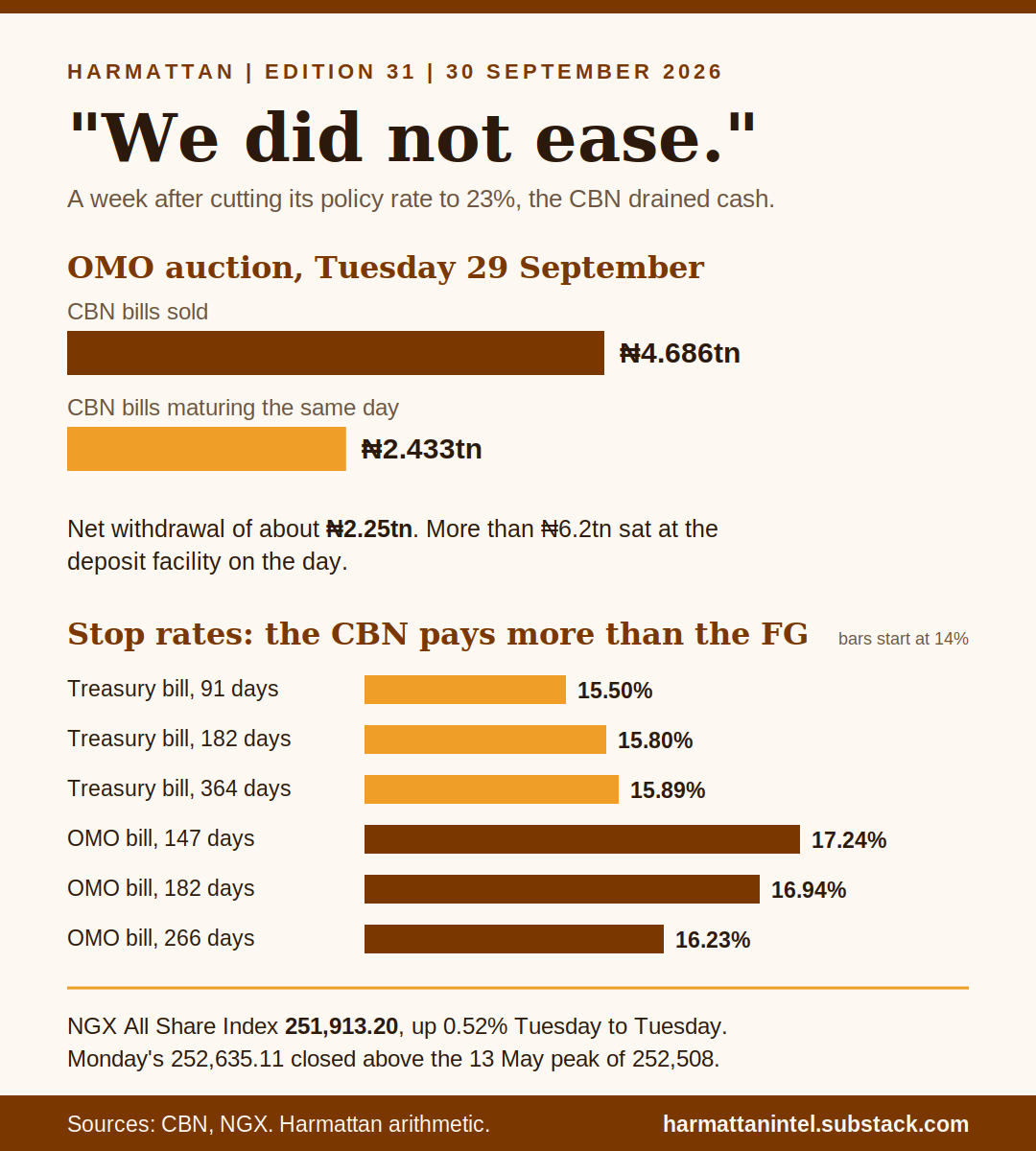
On Monday the NGX All Share Index closed at 252,635.11, above the 252,508 it reached on 13 May. On Tuesday, as the market gave part of that back, the Central Bank of Nigeria sold ₦4.686 trillion of its own bills, almost twice the ₦2.433 trillion it repaid the same day. A week after cutting its policy rate by 350 basis points, the bank was pulling cash out of the banking system at pace. One of its senior advisers had already explained why: “we did not ease.”
Market Wrap
The index closed Tuesday at 251,913.20, up 0.52 per cent from 250,614.66 a week earlier. Monday lifted it past its May peak before a 0.29 per cent retreat. Capitalisation also rose 0.52 per cent, to ₦163.53 trillion, after touching ₦163.999 trillion on Monday. In dollars, at the Central Bank’s weighted average rate, the market rose from $122.52 billion to $122.91 billion. The two measures moved together in every session, which means no new shares were admitted to swell the total. Monday’s close was a price gain, earned by existing holdings becoming more valuable rather than by fresh paper arriving on the board. About 4.85 billion shares changed hands across 249,591 deals over the five sessions.
Tuesday was a session of profit taking led by the banks. Volume fell to 548.67 million shares worth ₦34.29 billion across 47,301 deals, and GTCO dominated by value at ₦11.73 billion, ahead of Zenith Bank at ₦4.54 billion. LivingTrust Mortgage Bank and NPF Microfinance Bank each rose 10.00 per cent, to ₦2.86 and ₦4.40, followed by Wapic Insurance at 9.95 per cent. Sovereign Trust Insurance, the top gainer a week earlier, fell 9.92 per cent to ₦2.36, while Unilever Nigeria lost 8.55 per cent to ₦100.50 and Neimeth 6.02 per cent to ₦7.80. Sovereign Trust’s round trip, from the top of one Tuesday’s table to the bottom of the next, is the week in miniature: gains that arrived quickly were taken quickly.
₦4.686 trillion. The Central Bank’s sale of its own bills on Tuesday, a week after cutting rates, against ₦2.433 trillion it repaid that day.
The Big Story
The Central Bank’s decisions page records that the Monetary Policy Committee resolved to “reset” the policy rate at 23 per cent and “recalibrate” the corridor around it. Mayokun Ajibade, Special Adviser to the Governor on Financial Markets and Economic Policy, was blunter in a Nairametrics television interview reported by ThisDay: “we did not ease.” He described the stance as still highly restrictive.
Tuesday showed what that means. OMO bills are the Central Bank’s own short term paper, sold to absorb cash the system does not need. With ₦2.433 trillion of old bills maturing, the bank offered ₦2.5 trillion and sold ₦4.686 trillion, withdrawing about ₦2.25 trillion more than it paid back. September’s five OMO auctions sold about ₦17.5 trillion in all, and more than ₦6.2 trillion was still parked at the Central Bank’s deposit facility on the day.
So the price of money is falling while its quantity is held down. The first Treasury bill auction after the cut, on 23 September, cleared the 91 day bill at 15.50 per cent, the 182 day at 15.80 per cent and the one year at 15.89 per cent, with ₦497.59 billion allotted against a ₦500 billion offer. Tuesday’s OMO paper cleared higher: 17.24 per cent for 147 days, 16.94 per cent for 182 days and 16.23 per cent for 266 days. The Central Bank is paying more to borrow for five months than the Federal Government pays for a year.
For a diaspora investor or an institutional allocator, three things follow. Lending rates have not moved: nearly a week after the decision, an official at a Tier 1 bank told Nairametrics there were no plans to cut them, so the transmission the Central Bank wants is still to be proven. The front end of the naira curve has repriced quickly, and most of the gain on bills bought before the cut has been made. And the currency has barely moved. The official weighted average went from ₦1,327.78 on 22 September to ₦1,330.47 on Tuesday, with gross reserves at $54.92 billion. Monday’s turnover of $196.7 million was the lowest since 11 August. A steady rate on thin trading is calm, but it is not yet depth.
Nigeria’s Money
In August the Central Bank did something that has had less attention than the rate cut. A circular dated 12 August, issued by the acting director of its Financial Markets Department, allowed eligible investors, including individuals, companies and non-bank financial institutions, to buy OMO bills through their banks in both the primary and secondary markets. For decades this paper was a conversation between the Central Bank and the banks. Subscriptions reached ₦20.6 trillion across September’s first four auctions, up from ₦18.72 trillion in August.
Set that beside the savings account. The minimum savings rate now sits at 6.9 per cent; Tuesday’s shortest OMO bill cleared at 17.24 per cent; August inflation was 15.39 per cent. The distance between those numbers is the distance between a saver with an adviser and a saver with a passbook. The caveat has not changed. The reporting does not state the minimum an individual must bid, and Harmattan has not seen the circular itself. A reader asking a branch for OMO bills should ask what the minimum ticket is, what the bank charges to hold the paper, and how easily it can be sold before maturity. If the minimum is a sum most savers will never hold, access has widened in principle and not in practice.
Africa Watch
Ghana is running the test Nigeria has just begun. The Bank of Ghana held its policy rate at 14 per cent on 24 September with August inflation at 5 per cent, below the lower edge of its 6 to 10 per cent target band. The rate stood at 28 per cent in May 2025, so Ghana has halved it in about sixteen months. On Wednesday the bank’s director of research, speaking for Governor Johnson Asiama warned that a lower policy rate does not automatically or immediately bring cheaper loans. The lesson for Nigerian readers is about time: if Ghana, with inflation below target, is still pressing its banks to pass cuts on, a reset in Abuja will not reach a borrower’s statement in a matter of weeks.
What to Watch
Three things will show whether the reset reaches beyond the money market. The first is the fourth quarter Treasury bill calendar, not yet published, and the first auction under it, which will show how much the government means to borrow at under 16 per cent. The second is the first lending rate notice from a major bank; until one arrives, the cut has reached savers’ returns but not borrowers’ costs. The third is the Dangote Petroleum Refinery offer, which closes on 13 October; when the first subscription figure appears, its source deserves as much attention as its size.
For three years the Central Bank has argued that confidence comes before cheap money. This week it lowered the price and kept its hand on the quantity. The next answer belongs to the banks.
Tuesday to Tuesday changes, the five session volume and deal totals and the dollar conversion are Harmattan calculations, using daily NGX figures and Central Bank of Nigeria weighted average exchange rates.
Nothing published in Harmattan constitutes financial advice. Always consult a qualified financial adviser before making investment decisions.
Bestman Eleanya
Founder, Harmattan
hello@harmattanintel.com harmattanintel.substack.com