

Edition 24 | Wednesday 12 August 2026
Last week, this publication asked whether the Nigerian rally had run out of breadth. The market answered within a day, and then kept answering for four sessions before pausing to take profit. But the more
interesting development in Nigerian capital markets this week was not in Lagos, and it was not about price.
Market Wrap
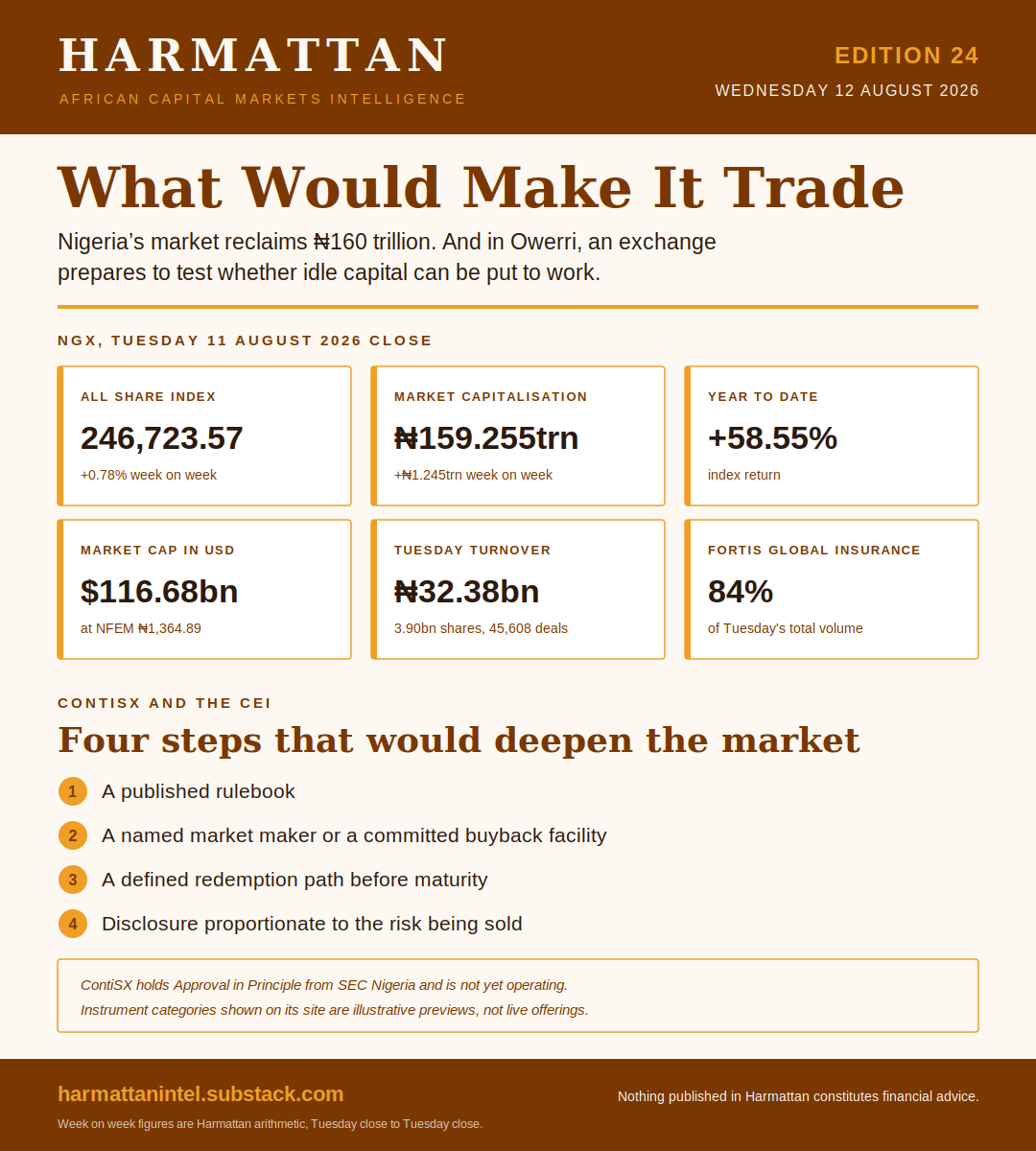
The All Share Index closed Tuesday at 246,723.57, up 0.78 per cent on the prior Tuesday close of 244,802.83, with market capitalisation at ₦159.255 trillion, a week on week gain of ₦1.245 trillion by Harmattan’s arithmetic from published daily closes, or roughly $116.68 billion. Year to date the index stands at 58.55 per cent. The path there mattered more than the destination. Friday closed at 245,573.60 on negative breadth. Monday then delivered the fourth consecutive advancing session, rising 1.20 per cent to 248,529.75 and adding ₦1.91 trillion to reach ₦160.42 trillion, the first close above ₦160 trillion since mid May. It was not a record, and it is worth saying so plainly, because the claim is circulating. The market touched ₦161.84 trillion with the index at 252,508.19 on 13 May, before June’s correction, and remains below both. Tuesday gave back 1,806.18 points, or 0.73 per cent, and ₦1.166 trillion, as profit taking hit MTN Nigeria, Dangote Sugar, Nigerian Breweries, First HoldCo, GTCO and Zenith. UPDC REIT led gainers at 10 per cent to ₦14.85, ahead of FTN Cocoa at 9.88 per cent to ₦8.90 and C&I Leasing at 8.26 per cent to ₦5.90. Thomas Wyatt led losers at 9.97 per cent to ₦2.89, followed by AVA Capital at 9.60 per cent to ₦8.95. Harmattan measures the week from Tuesday close to Tuesday close, which will not match the NGX Monday to Friday convention; dollar equivalents use the CBN NFEM closing rate of ₦1,364.89 on Tuesday 11 August.
Two details complicate the recovery. Monday’s gain came on negative breadth, 23 advancers against 36 decliners, because the session was essentially one stock: Airtel Africa rose 8.59 per cent, added ₦498.60 per share and became the most capitalised company on the exchange at ₦23.7 trillion. And Tuesday’s turnover, 3.90 billion shares worth ₦32.38 billion across 45,608 deals, was dominated by Fortis Global Insurance, which listed 15 billion additional shares on 30 July from a ₦12 billion debt to equity conversion at ₦0.80, taking its issued capital from 3.23 billion shares to 18.23 billion. Its percentage moves come off that reconstructed low base and are not ordinary price appreciation.
3.29 billion of 3.90 billion shares. By Harmattan’s arithmetic one recently reconstructed penny insurer accounted for 84 per cent of everything that changed hands on Tuesday, on an exchange with six decades of history behind it.
The Big Story
Somewhere in New Owerri, a few weeks from now, a securities exchange intends to open its doors. ContiSX Securities Exchange Plc holds Approval in Principle from Nigeria’s Securities and Exchange Commission, targets a launch on September 24, 2026, and has stated regional centres for Aba, Kano and Ibadan. The platform is not yet live, and the instrument categories displayed on its site are illustrative previews rather than anything anyone can buy today. That a serious piece of market infrastructure is being built outside Lagos, by a founder who has spent a career arguing that Nigeria’s constraint is capital mobilisation rather than capital scarcity, deserves acknowledging before anything else is said. Prof. Ndubuisi Ekekwe calls the founding idea investment inclusion. The diagnosis is right, and the diagnosis is usually the hard part.
The flagship product is the ContiSX Economic Instrument. A productive business, a film slate, a processing plant, a clinic, a school, would issue a standardised revenue backed security. Investors would buy fractional units carrying governance rights and a stated yield. The exit, as published, is scheduled redemption: at maturity the issuer repurchases the units at an agreed price, returning principal and return. It is worth being precise about what that is, because it would be easy to describe it as something missing. It is not. It is a fixed term instrument, and fixed term instruments are a legitimate and often sensible design. Nigerians already understand them intuitively. A commercial paper works this way. So does a fixed deposit, and so, in its own fashion, does a rotating contribution scheme. For a first time investor, a defined term and a defined return are considerably easier to hold than a price that moves every day for reasons nobody explains. ContiSX appears to have chosen clarity of terms over tradability, and for the constituency it is aiming at, that is a defensible choice rather than an oversight.
The open question is what happens to a holder who needs their money before the term ends, and this is the most useful thing for readers to watch between now and September 24, 2026. No market maker is named yet. No early redemption window is described. The Liquidity Notes product, whose name invites the assumption, addresses a different asset class in bank backed trade finance receivables. The depository being built alongside it is a separate and genuinely ambitious undertaking: cross border settlement against central bank money is something most African markets do not have, and attempting one in a first year is not a small thing to attempt. How it would interoperate with CSCS has not yet been set out. None of this is unusual for a venture still weeks from opening. It is simply the list of things that will determine whether a CEI is an instrument a cooperative can hold with confidence.
And it should be said clearly that nobody has solved this. SME secondary liquidity is among the hardest unsolved problems in capital markets, and it has defeated institutions far better resourced than any Nigerian start-up. NASD OTC has traded thinly for years despite doing a great deal well. Even on the NGX, as Tuesday’s tape showed, real liquidity gathers in a handful of names. Nor is credit risk peculiar to new venues. This week, Geregu Power, a listed, audited, and credit rated company with a bond on FMDQ and a trustee behind it, missed payment on ₦40.09 billion of Series 1 notes after first half revenue fell 78.71 per cent during a turbine overhaul. Defaults reach well documented issuers too. What the documentation does is turn a bad outcome into a recoverable one. Which is why four things, all of them within the company’s own gift before launch, would settle most of what remains open: a published rulebook, a named market maker or a committed buyback facility, a defined redemption path before maturity, and a disclosure regime proportionate to the risk being sold. None of those is a criticism. They are the ordinary furniture of a working market, and an exchange that arrives with them already in place starts with the thing most new venues spend years trying to earn.
Nigeria’s Money
Whether this works matters most to people who have never owned a security in their lives. Cooperatives, market traders, diaspora senders, and first time investors are precisely the constituency Nigeria’s formal capital market has never reached, and the capital drought they face is not theoretical. A woman running a food processing business in Aba with three employees, purchase orders she cannot fill, and no collateral any bank will accept is not short of ideas or customers. She is short of ₦4 million, and there is currently no institution in this country structured to hand it to her at a price she can survive. An instrument that routes idle household savings toward her is worth building, and worth being patient with while it is built.
The same constituency needs the terms explained precisely, which is where the responsibility sits and where it is entirely manageable. A cooperative member contributing ₦20,000 a month is not making a portfolio allocation. She is storing the money that covers school fees in January and a hospital bill nobody scheduled. A fixed term instrument can serve her very well, provided she understands that the term is the term, and provided the tenor is matched to money she can genuinely leave untouched. That is a question of disclosure and product design rather than of ambition, and it is the kind of thing a well written rulebook settles in a paragraph. Nigeria’s savers do not need protecting from new ideas. They need the terms in plain language before they subscribe.
Africa Watch
Old Mutual’s Zimbabwean shareholders get a tradeable price today for the first time in six years. The pan African insurer’s secondary listing migrates from the Zimbabwe Stock Exchange to the Victoria Falls Stock Exchange, with trading beginning on Wednesday 12 August after approval was confirmed in the first week of the month. The shares had been suspended on the ZSE since 2020, when the government halted trading to address currency instability. The bourse reopened. Old Mutual’s stock did not. The VFEX will suspend its usual price limits for the opening session so the market can find a level through submitted bids and offers, with the normal 20 per cent daily band applying from the second day. It is a reminder that markets can be repaired as well as broken, and that the repair usually comes from someone deciding to build a venue rather than complain about one.
What to Watch
Two dates. The Central Bank returned to the primary market on Wednesday 12 August with a ₦700 billion Treasury bill auction, and the stop rates that follow set the risk free hurdle every yield bearing instrument in Nigeria must clear. If government paper still pays double digits, the premium on any private yield is thinner than the headline suggests, and that arithmetic shapes what new issuers will have to offer. Then on Monday 17 August, the National Bureau of Statistics publishes July inflation, the final print before the September Monetary Policy Committee meeting. June came in at 15.91 per cent against 15.93 per cent in May, which is a stall rather than a decline. A third consecutive flat month would make the case for a September cut considerably harder to argue, and the fixed income market will price that well before equities do.
Exchanges are not built by approval. They are built slowly, by people willing to stand on both sides of a trade and by institutions that publish their terms before they ask for anyone’s money. Six weeks is not long. It is long enough.
Nothing published in Harmattan constitutes financial advice. Always consult a qualified financial adviser before making investment decisions.
Bestman Eleanya
Founder, Harmattan
hello@harmattanintel.com, harmattanintel.substack.com